Russia uses common and proven approaches in its attempts to influence electoral processes in other countries. Significant efforts are directed at Russian-speaking voters in these countries and at presenting the elections there to their own citizens in the light necessary for internal political stability within the Russian Federation itself.
Our research aims to analyze the main approaches of Russian information influence directed against state institutions and democratic values in post-Soviet countries, through the application of advanced media monitoring and analysis methods.
Based on this research, we can outline 13 main risks or 13 “gray rhinos” regarding a hypothetical election in Ukraine. These “gray rhinos” are identified based on lessons learned from our analysis of the election campaigns in Moldova and Georgia, as well as our own experience of the political processes in Ukraine since 2014 and attempts by Russia to influence them. Of course, there will be more once the elections are actually announced.
RESEARCH METHODOLOGY
During the 2024 election campaigns in Moldova and Georgia, Russian propaganda, media, and social media launched large-scale information campaigns targeting pro-European candidates, democratic institutions, and voters in these countries.
Our research aims to analyze the main approaches of Russian information influence directed against state institutions and democratic values in post-Soviet countries by applying advanced methods of media monitoring and analysis.
The main objectives of the research include:
- Tracking and analyzing hostile narratives in digital and traditional media.
- Identifying coordinated disinformation campaigns and their targets.
- Identifying the main risks for Ukraine during hypothetical elections.
- Developing strategic approaches to mitigate the impact of propaganda.
Research Tools:
Osavul– an AI-powered monitoring tool for real-time analysis of Russian digital media, including social media platforms.
War of Words – an AI-powered monitoring tool for real-time Russian TV and video content analysis.
KEY FINDINGS
Based on monitoring the 2024 elections in Moldova and Georgia, it can be stated: Russia is using common and proven approaches in its attempts to influence electoral processes in other countries. Significant efforts of malign campaigns are primarily aimed at Russian-speaking voters in these countries.
The analysis of Russian interference in the electoral processes of Georgia and Moldova is relevant for Ukraine for several reasons. Georgia and Moldova have a similar to Ukraine history of European integration attempts, such as participation in GUAM (Organization for Democracy and Economic Development) and the Eastern Partnership, similar post-Soviet transformation processes of institutions, and a long history of Russian attempts to influence their policies, including using military instruments.
EXPLOITATION OF THE FEAR OF WAR
EXPLOITATION of the fear of war is one of the key and most effective tools of Russian propaganda and operations of influence. This is especially true for countries that have already had experience with Russian military aggression against them. Such countries are Georgia and Moldova, where the wars with the Russian Federation have left a deep mark on the public consciousness of the local societies, forming a fear of repeated aggression.
MANIPULATION OF THE ISSUE OF FROZEN CONFLICT
MANIPULATION of the issue of frozen conflicts and territories occupied by Russia is another effective tool related to the exploitation of the fear of war. This tool was very actively used by the Kremlin in the election campaigns of Georgia and Moldova.
In particular, as a new casus belli on the one hand, and on the other, as a possible reward for the right vote or geopolitical vector.
SPREADING EUROSCEPTICISM
EUROSCEPTICISM IS ONE OF THE MOST IMPORTANT TOOLS OF RUSSIAN propaganda, along with the fear of war and the manipulation of the issue of occupied territories.
Russian propaganda systematically spreads the strategic narrative that European integration does not lead to positive changes for Georgian and Moldovan societies, but, on the contrary, causes economic deterioration and an outflow of people from these countries. Therefore, in addition to the fear of a repeat of war, Russian propaganda uses existing economic problems and links them to the European vector of the countries and the ineffectiveness of the reforms that this vector requires.
The narrative of the “colonial West” was actively used during the elections in Moldova and Georgia. According to it, Western powers treat these countries and the local population as colonies and are only interested in resources and cheap labor.
Instead, another geopolitical vector – not openly called pro-Russian, but rather “pragmatic” – is presented to voters as one that can improve their financial situation through cheap energy for the population and businesses, more open markets, and similarity of business practices.
Narratives about the West’s forced imposition of “LGBT ideology” and manipulation of the issue of involving children in it also play an active role in promoting Euroscepticism. Russian propaganda portrays Western cultural expansion as a threat to national identity, emphasizing the need to protect traditional values such as family, religion, and national unity from the “subversive” influences of the West.
Russia is making great efforts to undermine the institution of elections and faith in democratic procedures: the formation of distrust in the process of expressing will is one of the key elements of Euroscepticism.
ATTACKING SPECIFIC POLITICIANS
Attacking specific politicians has been systematically used by Russian propaganda to influence elections in Moldova and Georgia. The Russian approach involves not only promoting its own narratives, but also trying to increase the chances of some politicians and political parties and sharply reduce the chances of being elected by others.
For example, in Moldova, the task of the Russian propaganda information campaign was not to promote alternative candidates, but to undermine the rating of the pro-European participant in the race, Maia Sandu.
Georgia held parliamentary elections in 2024. Nevertheless, Russian propagandists have intensified their campaign against pro-European President Salome Zurabishvili.
Given the lessons learned from Russia’s interference in the 2024 elections in Moldova and Georgia, we can talk about the most likely approaches to interfering in the Ukrainian elections, once they are announced:
PROMOTING EUROSCEPTICISM IN UKRAINE
FOR obvious reasons, during the election campaign, none of the Ukrainian politicians will directly express narratives about the need for close ties with Russia. Instead, Russian propaganda and operations of influence will focus from the outset on promoting Euroscepticism as a strategic narrative. Accordingly, they will promote Eurosceptics, who will also not be called like that, but rather their working title will be “pragmatists.”
The most common narratives, partly based on real feelings that one might expect, include: “The West has abandoned us,” “We gave away the third-largest nuclear arsenal in the world, and in return, we asked only for guarantees of our territorial integrity – even here we were deceived,” “Western companies are not interested in our well-being; they only need our resources and cheap labor,” “Ultimately, the European path led us to war and economic collapse.”
ULTRA-NATIONALIST, XENOPHOBIC, ANTI-LIBERAL AGENDA
THE effort to promote Euroscepticism and reduce support for integration processes will be linked to another process – the efforts of Russian propaganda to play on xenophobia, intolerance, and anti-liberal sentiments. This allows demonstrating to Ukrainian citizens that the so-called “European values” have unacceptable components.
Along with spreading Euroscepticism among Ukrainians, this allows for the spread of “Ukrainian scepticism” among European officials and decision-makers. It will also facilitate an operation of influence within EU countries to discredit Ukraine among local politicians and societies.
MANIPULATION OF THE PROBLEM OF CORRUPTION
THE issue of corruption is very resonant in Ukrainian society and is often used to describe many aspects of public life in the country. It provokes active discussions even during the war. The topic of corruption, in addition to its real component, will become one of the main topics of Russian propaganda in its efforts to influence the electoral process – this applies to both presidential and parliamentary elections. This topic will also be used to promote Ukrainian scepticism in the EU, the UK, and the US.
DISCREDITATION OF TOP OFFICIALS TO DEPRECIATE THE RESISTANCE
THE current hot phase of the war, in the absence of new full-scale attacks by the Russian Federation, will become a cultural trauma and the central political myth of the Ukrainian nation. Therefore, the efforts of Russian propaganda to undermine the authority of the military political leadership of Ukraine in order to discredit the Ukrainian resistance from the very beginning of the full-scale invasion have much more far-reaching goals. By discrediting specific figures in the leadership, Russian narratives aim to minimize the historical significance of Ukraine’s resistance, reducing it to the result of decisions made by a few individuals in Ukraine and the West.
The ultimate goal of these efforts is not merely to attack individuals but to desacralize the collective heroism of Ukrainian citizens during the invasion. Simultaneously, these narratives attempt to shift blame for the war onto Ukraine’s military-political leadership, framing their actions as having provoked Russia’s aggression.
DIVIDING SOCIETY ON THE ISSUE OF PARTICIPATION IN THE WAR
AFTER the start of the election campaign, the issue of participation versus non-participation in the war will likely be brought into the public sphere to deepen societal divisions for political purposes—something Russian propaganda will undoubtedly exploit. This criterion will almost certainly play a significant role in the political race, and as a result, potential candidates are already negotiating with prominent military figures to join their teams.
MANIPULATION OF THE LANGUAGE ISSUE
The issue of the Russian language has been central to Russia’s attempts to influence Ukraine’s domestic and foreign policy for the past three decades since the collapse of the USSR. It is no coincidence that, after the start of the full-scale invasion, Russia demanded official status for the Russian language in its ultimatum.
One of the main Russian propaganda narratives is the alleged oppression of the Russian-speaking population in Ukraine. This narrative has served as a justification for the full-scale invasion, as well as for the earlier annexation of Crimea and occupation of parts of the Donetsk and Luhansk regions.
Russian propaganda directly and indirectly equates being Russian-speaking with belonging to the Russian nation, thereby denying Ukrainian identity and nationality.
It will undoubtedly continue using this narrative during any future election campaign in Ukraine – and, importantly, has not ceased doing so even during wartime.
DIVIDING SOCIETY ON THE CHURCH ISSUE
Russian propaganda seeks to reframe the issue of the Ukrainian Orthodox Church (Moscow Patriarchate) not as a political or institutional matter, but as a broader religious persecution narrative, claiming oppression of Orthodox Christians by Ukrainian authorities. It is clear that the status and functioning of the UOC (MP) will serve as a key tool for Russian propaganda in influencing any hypothetical Ukrainian elections, acting as both a wedge issue and a political litmus test.
SPECULATION ABOUT OCCUPIED TERRITORIES
Manipulation of the topic of occupied territories is a well-established tool of Russian propaganda, used previously in Moldova and Georgia. In Ukraine, it was heavily employed between 2014 and 2022, and remains a feature of Russia’s influence operations today.
While this narrative may now be more limited than during 2014-2021, given that Russia has formally integrated these territories into its Constitution and foreclosed the path to voluntary withdrawal or negotiated return, it will still be used. Even in a more restricted form, Russian propaganda and some Ukrainian political actors will likely employ these narratives during the election campaign to undermine national unity.
THREAT OF A NEW FULL-SCALE INVASION
THE threat of another full-scale Russian attack will almost certainly be leveraged during Ukraine’s election campaign. This risk is even more acute for Ukraine than it was in the cases of Georgia and Moldova, as the memory of the current war will still be fresh. The fear of renewed aggression, especially after a short period of relative calm and citizens’ efforts to return to normal life, will be a powerful emotional trigger that Russian propaganda will exploit.
BLURRING RESPONSIBILITY
This approach cannot be used during the active phase of the war. However, with the cessation of hostilities and the start of the election campaign, one should expect active efforts to establish connections “between people”. This tool holds significant potential for Russian propaganda, as it seeks to deny the Russian Federation’s deliberate attempt to destroy the Ukrainian nation through aggressive war, instead attributing the conflict to vague disagreements between political elites. While cultural, scientific, civil society, and religious figures on both sides will demonstrate understanding of the need for dialogue that will put the entire list of Russian war crimes against Ukraine out of brackets.
ESTABLISHING UNOFFICIAL POLITICAL TIES
The Russian side will most likely use another approach, which is not new, in its attempts to influence the political agenda in Ukraine. This approach is to establish political ties without giving them official, state status. Similar attempts were made before the full-scale invasion by Viktor Medvedchuk, involving French and German parliamentarians, to legitimize his open relations with the Russian ruling “United Russia” party.
Such efforts, even involving intermediaries like European politicians, are unlikely to succeed during a hypothetical election campaign. However, one can expect attempts to establish close ties with far-right and far-left parties against the backdrop of criticism of liberal values and the spread of Euroscepticism. There is also a high probability of cooperation during the election campaign of individual Ukrainian political actors and/or forces with Viktor Orban’s Hungarian “Fidesz” party and Robert Fico’s Slovak “Kurs – Social Democracy” party.
VOTER BRIBERY BY ORGANIZED NETWORKS
Russia’s use of voter bribery was more likely in Moldova and Georgia because of their smaller populations. In addition, the Russians had the time and unhindered access to these countries to systematically work on building a network of political bribery, primarily with local authorities who worked directly with voters.
Once hostilities cease and hypothetical elections are announced, Russia will likely lack the time needed to establish a comprehensive bribery network in Ukraine. Nevertheless, it is likely that the Kremlin will attempt to influence individual political actors or parties in Ukraine. This will most likely happen through intermediaries in European countries or with the help of the already mentioned political parties representing the ultra-right and ultra-left spectrum.
CREATION OF A COORDINATED NETWORK OF CHANNELS ON VARIOUS PLATFORMS
With the loss of importance of traditional media, primarily TV channels, Russian propaganda will use YouTube channels, and for the rapid dissemination of certain narratives, Telegram, TikTok, and Instagram platforms. Therefore, during a hypothetical election campaign in Ukraine, one should expect active disinformation efforts and influence operations by Russia on these platforms.
According to IKAR’s survey among Ukrainian youth aged 18 to 26 in the spring of 2024, the absolute majority named Telegram as their main source of news. TikTok and Instagram were in second and third place, respectively. The effectiveness of these tools for spreading disinformation and manipulating electoral sentiment lies not only in the immediacy of information dissemination but also in the uncritical perception of this information by consumers in the stream of videos and messages they watch for entertainment or recreation.
Thus, we can identify several obvious ways to counter Russian interference in a hypothetical election in Ukraine.
DETAILED AND DATE-TIED PLAN FOR UKRAINE’S EU ACCESSION
The case of Georgia clearly demonstrates what a half-opened door policy leads to. Currently, it is a regime completely loyal to the Kremlin, which de facto came to power before 2024. Last year, it only consolidated its Euroscepticism and copying of Russian authoritarian practices.
The same scenario is quite likely for Ukraine – the growth of Eurosceptics who will talk about pragmatism, in particular in negotiations with the EU, postponing and complicating them.
Due to military, geopolitical, social, demographic, economic, and other factors, this accession should take place over a period of 5-7 years with a defined step-by-step program tied to specific dates.
A clear European perspective will make it possible to counteract active post-war attempts by Russian propaganda and multi-level influence operations at the strategic level to turn Ukraine into a “gray zone,” and then into an analogue of modern Georgia, or in the worst case, Belarus.
Thus, at the tactical level, there will immediately be an opportunity to counteract one of Russia’s most effective approaches to interfering in elections in the post-Soviet space – Euroscepticism, by foreseeable in time joining the European Union.
RECONSTRUCTION OF UKRAINE AND JOINT LARGE-SCALE PROJECTS WITH THE EU
LARGE-SCALE reconstruction of the country and joint investments with European partners would be a natural and clear demonstration of Ukraine’s real commitment to joining the EU.
As the elections in Georgia and Moldova have shown, Russian propaganda actively appeals to economic problems, blaming them on the European integration aspirations of post-Soviet countries.
Ukraine was not and will not be an exception in the future. Especially since the war of attrition without large-scale support and reconstruction assistance from the EU will create fertile ground for this kind of manipulation during election campaigns.
ASSISTANCE OF EUROPEAN COUNTRIES IN THE RETURN OF REFUGEES TO UKRAINE
The problem of depopulation was relevant for Ukraine even before the start of the Russian-Ukrainian war in 2014 and, even more so, in 2022. The full-scale invasion brought it to the forefront and made it one of the most acute issues for the Ukrainian state for the next decades. In addition to the losses in the war and the population that remained in the territories occupied by Russia, today the number of Ukrainian refugees is between 6 and 8 million.
Over time, more and more Ukrainian citizens are solving the “refugee dilemma” not in Ukraine’s favor. However, European countries can contribute to solving this problem, for example, by reducing aid to refugees and encouraging them to return to Ukraine as soon as the security situation allows.
The return of these people should become another factor in the democratic nature of future hypothetical elections in Ukraine. This category of citizens, who experienced the need to leave their country due to Russia’s aggressive war, will also become an additional obstacle to the implementation of the “Georgian scenario” in Ukraine. They are not a guarantee, but rather an important component in this process.
CONSIDERING THAT RUSSIA WEAPONIZES ALMOST EVERYTHING
EUROPE and the “collective West” must recognize that Russia, in its malign activities, uses as a weapon (weaponizes) absolutely everything: language, religion, the rights of national minorities, democratic institutions, and, of course, the media and communications. When we recognize that absolutely everything can be used as a weapon, we see much more clearly the attempts of Russian propaganda to interfere in the electoral process.
According to IKAR’s long-term media analysis, Russian propaganda actively uses social networks in its information, psychological, and influence operations. Social networks, due to their popularity, are ingrained in the everyday lives of citizens, and their entertainment nature provides a wide space for this kind of malicious activity. In other words, Ukrainians use them for entertainment and recreation, but ultimately become objects of manipulation for political and military-political purposes. This is especially true of TikTok and Telegram.
It is obvious that there is a need for general parameters for a mechanism to counter the distortion of the democratic process through social media.
It is also obvious that when developing such a countermeasure, one cannot be guided by a formal approach to legislation. Since Russian propaganda often appeals to the protection of human rights in order to destroy these rights, weaponizing what it intends to dismantle or destroy entirely.
LESSONS FROM THE ELECTIONS IN MOLDOVA AND GEORGIA
Russia uses common and proven approaches in its attempts to influence electoral processes in other countries. Significant efforts are directed at Russian-speaking voters in these countries and at presenting the elections there to their own citizens in the light necessary for internal political stability within the Russian Federation itself.
The approaches and narratives outlined below were clearly evident during the referendum and presidential elections in Moldova and the parliamentary elections in Georgia in the fall of 2024. Both countries share many similarities with Ukraine, so Russian propaganda and disinformation methods are relevant to it as well. Moreover, a significant number of these methods were already tested in Ukraine long before the full-scale invasion of 2022.
Georgia and Moldova share a similar to Ukraine history of European integration attempts, such as participation in the GUAM organization and the Eastern Partnership, as well as similar post-Soviet transformation processes of institutions, and a long history of Russia’s attempts to influence their policies, including using military instruments.
Let’s consider the main approaches used by the Kremlin during the fall 2024 elections in Georgia and Moldova.
1. EXPLOITATION OF THE FEAR OF WAR
Exploitation of the fear of war is one of the key and most effective tools of Russian propaganda and operations of influence.
This is especially true for countries that have already had experience with Russian military aggression against them. Such countries are Georgia and Moldova, where the wars with the Russian Federation have left a deep mark on the public consciousness of the local societies, fostering a fear of repeated aggression.
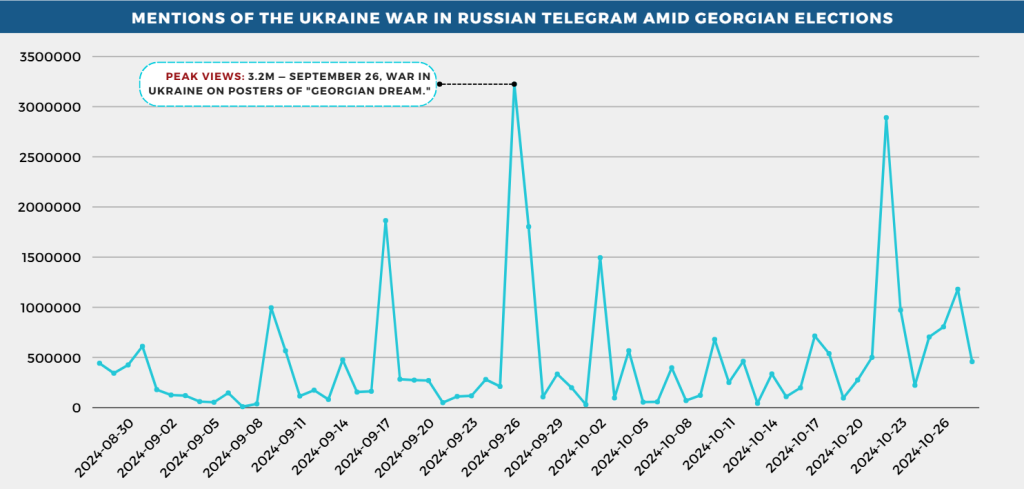
Taking advantage of the full-scale invasion of Ukraine, Russia has taken the ideology of war to a new level, using it as an acceptable and even routine tool of influence. The tool of fear of war was used especially actively by the Russian side during the election campaigns in Georgia and Moldova in the fall of 2024.
The topic of the war in Ukraine became a key element of the “Georgian Dream” election campaign, actively used to provoke anti-European sentiments. On September 26, 2024, the number of views of Telegram messages regarding the parliamentary elections in Georgia in the context of the Russian-Ukrainian war reached 3.2 million (in the Russian segment). On that day, the pro-government party first used comparative images of war-torn Ukrainian cities and “peaceful” Georgian cities.
2. MANIPULATION OF THE ISSUE OF FROZEN CONFLICT
Manipulation of the issue of frozen conflicts and territories occupied by Russia is another effective tool related to the exploitation of the fear of war.
This tool was used very actively by the Kremlin in the election campaigns of Georgia and Moldova.
In particular, it was used both as a new casus belli on the one hand, and on the other, as a possible reward for voting in line with the Kremlin’s desired geopolitical direction.
This topic has always been brought up by Moscow in order to exert influence on the official Chisinau or its politicians. The current electoral cycle was no exception. The topic of Transnistria was widely covered on propaganda channels and the RuTube platform, sometimes even more frequently than the presidential elections in Moldova themselves. This emphasizes how important the topic remains in the Russian information space.
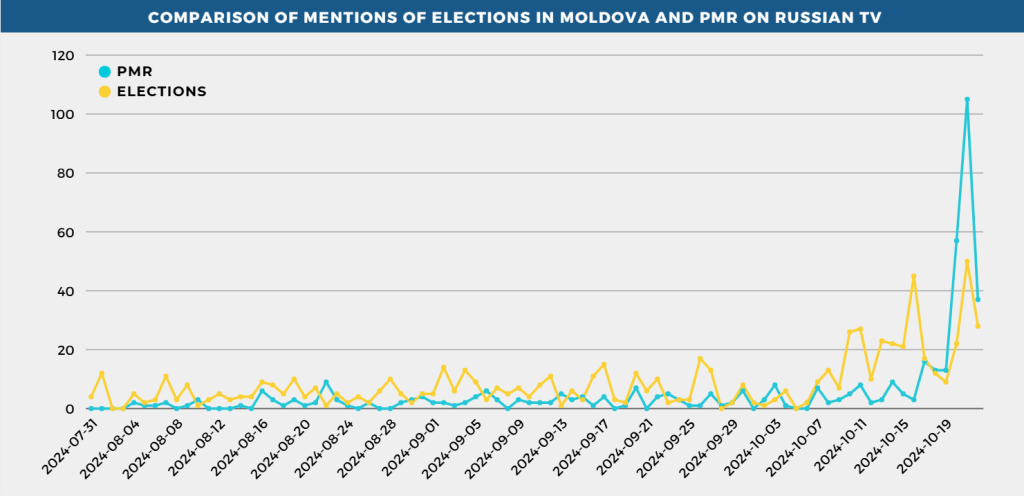
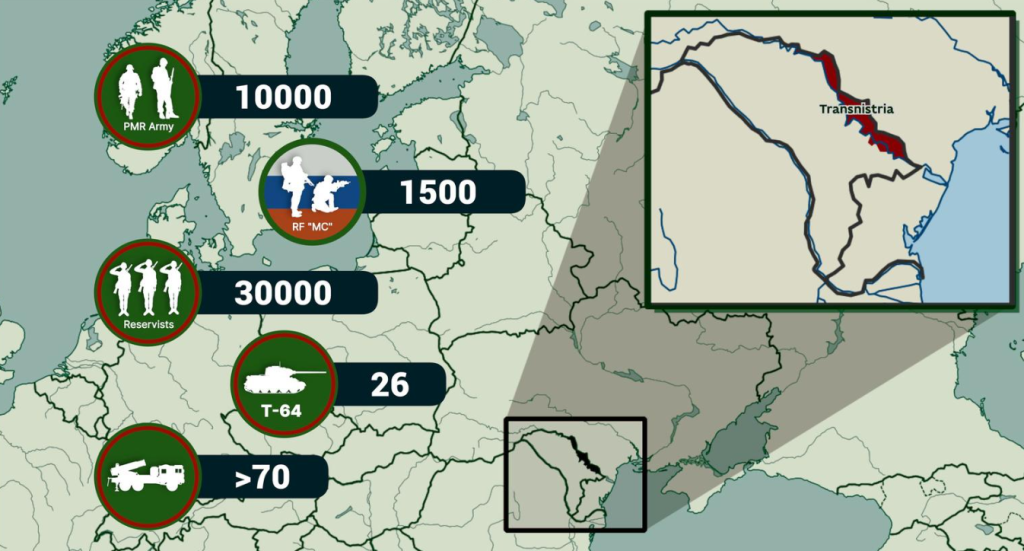
In general, this tool is not new. Since Moldova gained independence in 1991, Russia has consistently tried to maintain its influence in this country, using all available means. One of the main ones has been support for the separatist entity – the Transnistrian Republic, where a Russian military contingent of about 1,500 contract soldiers is still stationed.
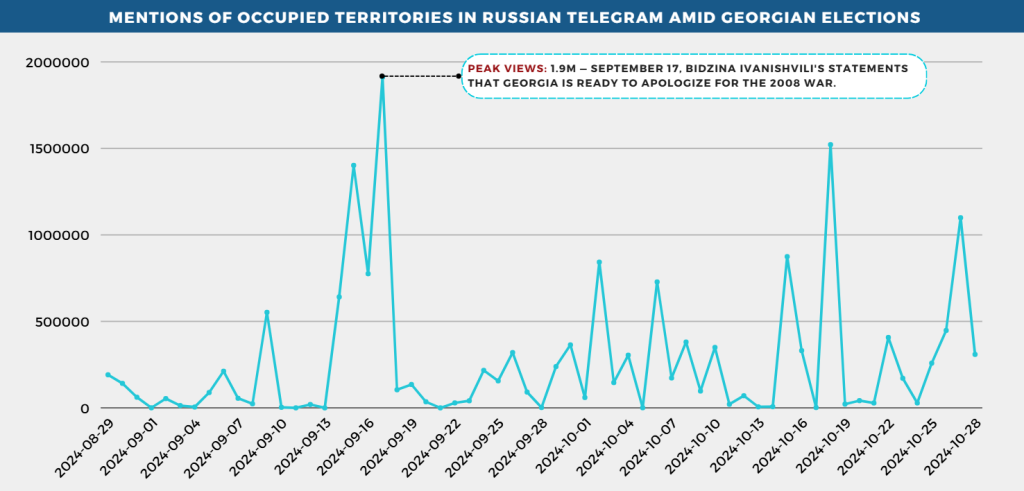
The occupied territories of Georgia were also repeatedly mentioned in the election campaign on the eve of the parliamentary elections. The main narrative regarding these quasi-republics was the Kremlin’s aggressive rhetoric about the inevitable escalation of the conflict in the event of the victory of the opposition forces in the elections in Georgia and, conversely, their potential reintegration in the event of the victory of the pro-government party.
In particular, on September 17, 2024, the number of views of messages regarding Bidzina Ivanishvili’s statement that Georgia is “ready to apologize for the 2008 war” reached almost 2 million (in the Russian segment of Telegram).
Russia is conducting demonstration joint exercises with armed formations in the uncontrolled territories of Moldova and Georgia.
Open threats of escalation and the transition of a frozen conflict into a state of military confrontation are always accompanied by covert influence operations aimed at undermining the Western-oriented course of these countries. The main goal of such a combined influence is to create negative collocations for the European integration narrative and force voters to focus on the fear of escalation.
Thus, Russian propaganda is trying to make it more likely that support will be given to those candidates who promise “peace” and “the return of territories” – usually those who have ties to Russia and, accordingly, will not pursue a policy of European integration.
3. SPREADING EUROSCEPTICISM
Euroscepticism is one of the most important tools of Russian propaganda, along with the fear of war and the manipulation of the issue of occupied territories.
Russian propaganda systematically spreads the strategic narrative that European integration does not lead to positive changes for Georgian and Moldovan societies, but on the contrary, causes economic deterioration and an outflow of people from these countries. Therefore, in addition to the fear of a repeat of war, Russian propaganda exploits existing economic problems by linking them to the countries’ European ambitions and the ineffectiveness of the reforms that this path requires.
The strengthening of Euroscepticism takes place not due to open pro-Russian propaganda, but rather through the amplification of these narratives by local politicians and political forces. These political actors actively disseminate narratives that equate support for pro-European candidates with a desire for military escalation. Thus, they form an idea of the West’s alleged plans to militarize the region, creating an atmosphere of fear and increasing distrust of the European course of development.
The narrative of the “colonial West” was actively used during the elections in Moldova and Georgia. According to it, Western powers treat these countries and the local population as colonies, interested only in their resources, cheap labor, and in using them as proxies for military confrontation with the Russian Federation.
Instead, another geopolitical vector – not openly called pro-Russian, but rather “traditional” – is presented to voters as one that can improve their financial situation through cheap energy for the population and businesses, more open markets, and similar business practices.
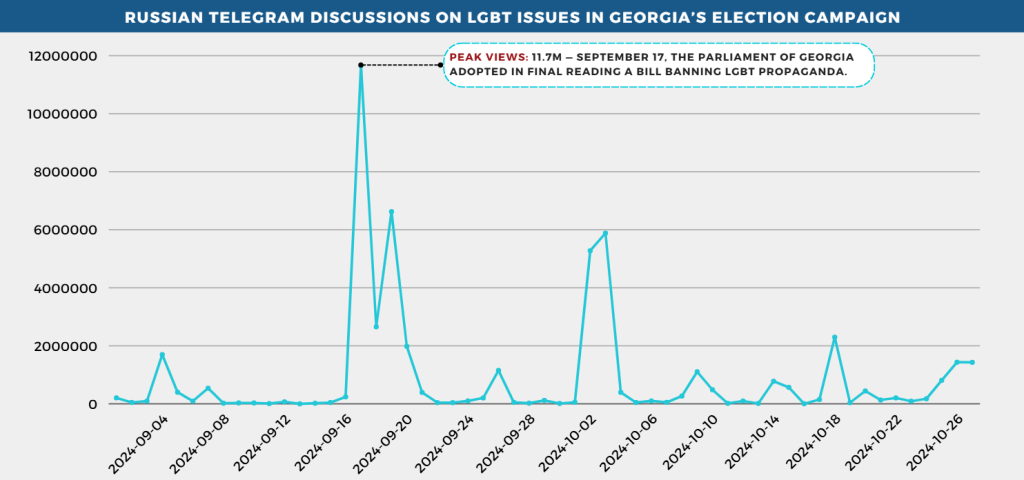
Narratives about the West’s forced imposition of “LGBT ideology” and manipulation of the issue of involving children in it also play an active role in promoting Euroscepticism.
These narratives were used very actively during the election campaign in Georgia. During August-October 2024, 3600 relevant messages were published in the Russian segment of Telegram alone, which received 51 million views and almost 1.1 million reactions, half of which were negative.

In general, Russian propaganda systematically intensifies homophobic sentiments in many countries and actively cooperates with far-right political parties and movements. Along with the fear of war and economic turmoil during elections in these countries, European integration is equated with consent to the active promotion of LGBTQI+ values.
Narratives about the West’s forced imposition of “LGBT ideology” and manipulation of the issue of involving children in it also play an active role in promoting Euroscepticism.
These narratives were used very actively during the election campaign in Georgia. During August-October 2024, 3600 relevant messages were published in the Russian segment of Telegram alone, which received 51 million views and almost 1.1 million reactions, half of which were negative.
In general, Russian propaganda systematically intensifies homophobic sentiments in many countries and actively cooperates with far-right political parties and movements. Along with the fear of war and economic turmoil during elections in these countries, European integration is equated with consent to the active promotion of LGBTQI+ values.
4. ATTACKING SPECIFIC POLITICIANS
Russia is actively trying to reduce support for pro-Western politicians and increase the electoral chances of their opponents.
The Russian approach involves not only promoting its own narratives, but also trying to increase the chances of some politicians and political parties and significantly reduce the chances of others being elected.
This was clearly demonstrated by the election campaigns in Moldova and Georgia. Since the official start of the electoral campaign in August 2024, the elections in Moldova have attracted significant attention from Russian media and have been actively discussed on Russian social networks.
If we look at the frequency of mentions on Russian television of the main presidential candidates in Moldova, we can assume that Russian propaganda was pushing for the victory of the incumbent president, Maia Sandu. From a quantitative point of view, Sandu’s name was heard much more often in the news and political talk shows than the name of the opposition candidate, Oleksandr Stoyanoglu.
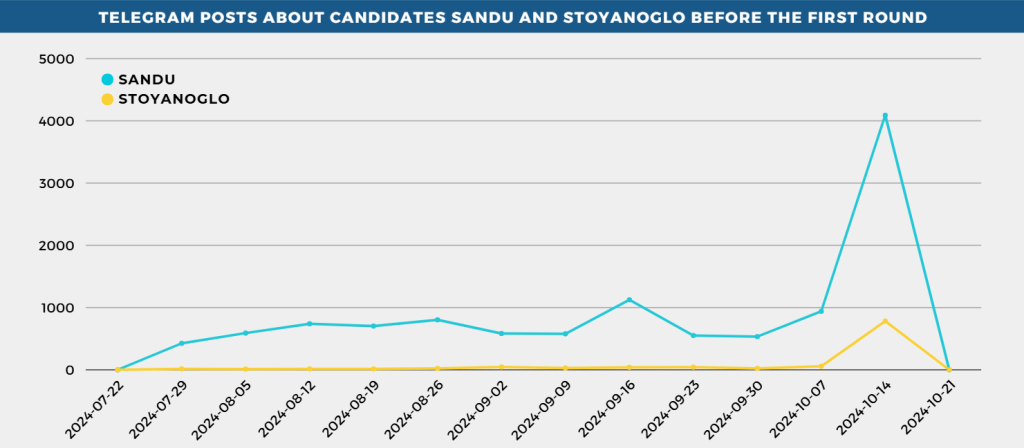
As in the case of propaganda TV shows, topics related to Maia Sandu were discussed significantly more often in the Russian segment of Telegram compared to those about opposition candidate Oleksandr Stoyanoglo.
However, the quantitative indicators did not mean that the content of the publications was aimed at promoting candidate Maia Sandu. On the contrary, most mentions of the incumbent President of Moldova in the Russian segment of Telegram and on Russian state television were negative. This happened both during the first round of the elections and the referendum on European integration, and during the second round.
It should be emphasized that the goal of the Russian propaganda information campaign was not to promote alternative candidates but to undermine the support for the pro-European participant in the race, namely, Maia Sandu.
The results of a comparative analysis of the number of publications, presented in the graphs below, indicate that the Russian information campaign focused mainly on Sandu, apparently with the aim of forming a negative attitude towards the current president among the Russian-speaking audience.
As a result, the incumbent president was mentioned in a sharply negative context and far more frequently than her opponent, opposition candidate Oleksandr Stoyanoglo. The main narratives covered on Russian TV regarding the elections and Maia Sandu referred to the following topics: the sale of land to foreigners, a referendum on the territory of the Transnistrian Republic, the narrative that Maia Sandu’s victory would be “purely technical”, repression of the opposition for criticizing the pro-European course, and negative economic processes as a result of European integration.
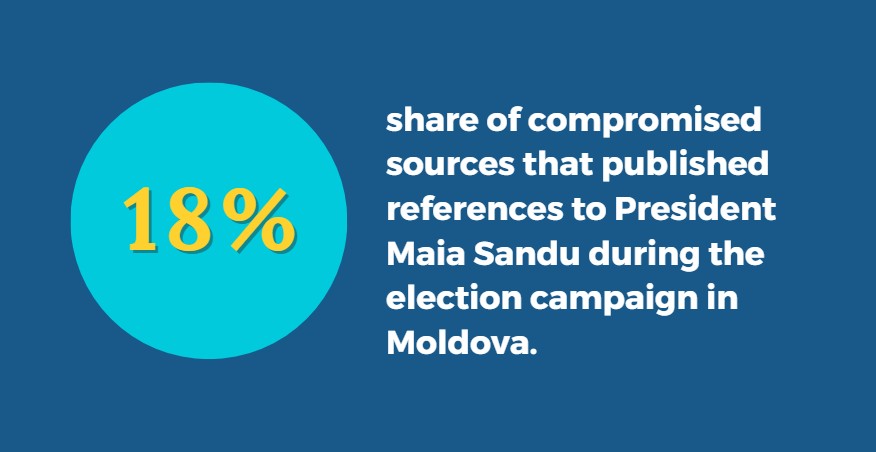
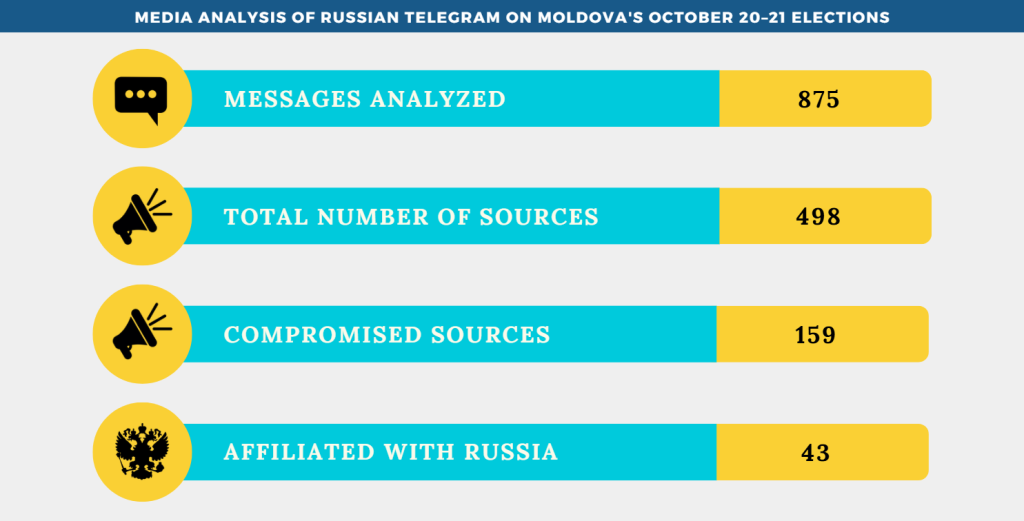
Among the 498 sources that covered the elections in Moldova during the voting and vote counting on October 20-21, 2024, 159 Telegram channels were identified as compromised – their activities are related to Kremlin information campaigns and manipulation of public opinion aimed at media influence on the audience. Thus, almost every third source involved in campaign coverage was compromised.
It is important to emphasize that the involvement of such sources during election coverage in Moldova was twice as high as the average use of similar channels for other operations of influence: usually, their share is 15%.
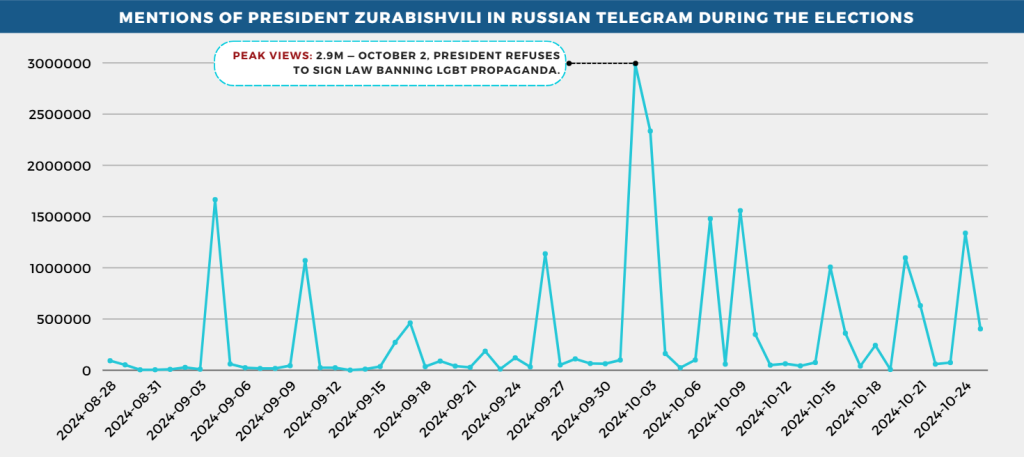
A similar situation was recorded during the campaign in Georgia. Although it was not a presidential election, but a parliamentary election. Nevertheless, Russian propagandists intensified their campaign against pro-European President Salome Zurabishvili, in particular after her refusal to sign the Law on the Prohibition of LGBT Propaganda on October 2, 2024. The corresponding Telegram messages in Russia have garnered almost 3 million views.
On October 6, 2024, the Speaker of the Georgian Parliament Shalva Papuashvili announced a new attempt to impeach Salome Zurabishvili. This news was viewed by 1.5 million users of the Russian segment of Telegram.
During the election campaign in Georgia, over 25% of Telegram messages about Salome Zurabishvili were spread by compromised propaganda sources. At the same time, the share of negative reactions exceeded 36%.
On October 26-27, 2024, during the days of voting and vote counting, over 3,000 messages about the elections in Georgia were published in the Russian segment of Telegram, which received 48.8 million views. The share of negative reactions reached 40%.
The election campaign in Georgia also demonstrated that Russian propaganda can not only reduce the ratings of pro-Western politicians and political parties. It can direct its efforts to promote “Eurosceptics” and, even more so, those who express pro-Russian positions.
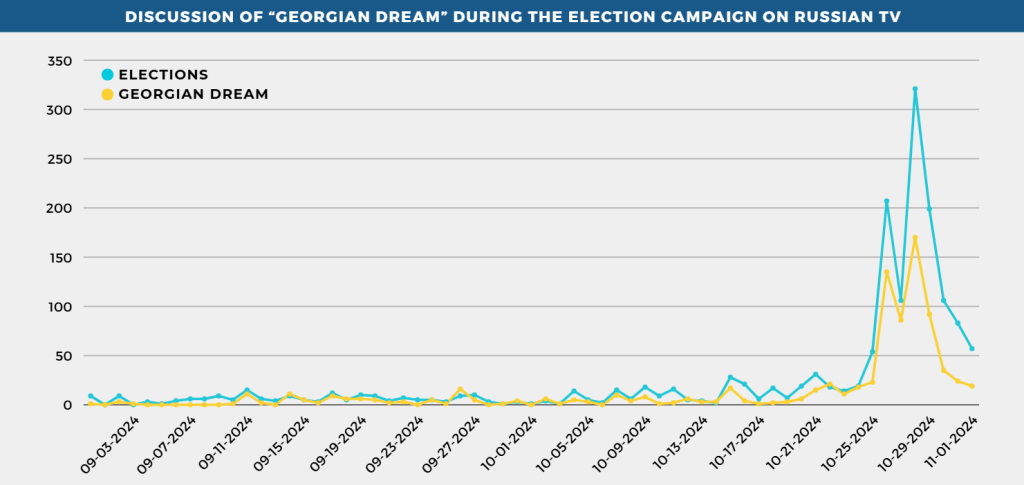
The election campaign in Georgia, which began on August 28, 2024, has sparked active discussions in Russian media. The main discussions have mostly focused on the country’s geopolitical course and the political program of the ruling “Georgian Dream” party.
As the graph shows, frequent mentions of the elections in Georgia on Russian television were accompanied by discussion of the pro-government “Georgian Dream” party, which indicates an active information campaign.
In addition, Russian propaganda actively promoted the “Georgian Dream” among Russian-speaking users on the Telegram network. According to the analysis, the share of compromised sources that spread positive narratives about the pro-government party reached 21%, while the average figure does not exceed 15%.
This indicates Moscow’s full support for the “Georgian Dream” agenda. The way Russian propaganda covered this political party is very similar to how it covered the pro-Russian force “Opposition Platform – For Life” in Ukraine before the start of the full-scale invasion.
In addition, the pro-European opposition protests in Georgia in November-December 2024 and the narratives surrounding these events are also very similar to those seen during the 2013-2014 Euromaidan.
5. Undermining Trust in Institutions
Russia is undermining the foundations of trust in democratic electoral procedures.
Hostile propaganda focuses on any procedural flaws or “controversial” policies to undermine confidence in state institutions.
At the same time, Russia positions itself as a guarantor of stability, implying that democratic systems are weak and that only Moscow’s influence can provide security. When faith in democracy weakens, voters become more vulnerable to Russian narratives, perceiving them as a pragmatic alternative.
As part of its strategic goal of undermining pro-European sentiment, Russia is making great efforts to undermine the institution of elections and faith in democratic procedures. In other words, the formation of distrust in the process of expressing will is one of the key elements of Euroscepticism.
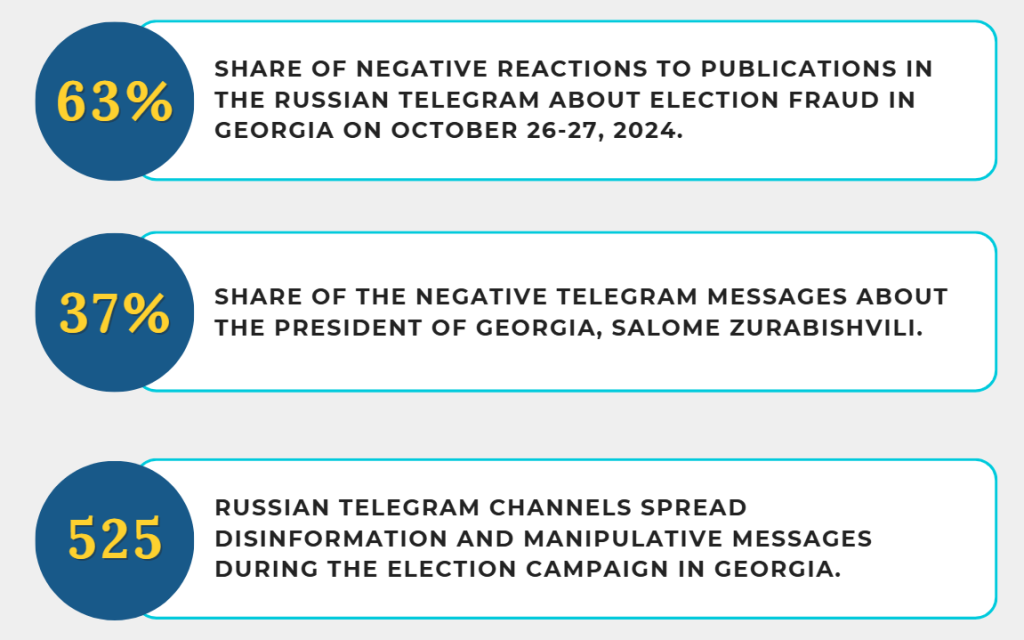
During the Moldovan elections, Russian propaganda claimed massive fraud and violations from the very morning of the first round of voting and the referendum on European integration. The same thing happened on the day of voting and vote counting in the parliamentary elections in Georgia. Messages about falsifications received over 14 million views and 300 thousand reactions in the Russian segment of Telegram in a single day, most of which (63%) were negative.
In this proven way, the Kremlin created a situation of uncertainty, where Russian propaganda could impose an agenda, and official Moscow could strengthen its position by recognizing or not recognizing the democratic nature of the elections, depending on which candidate or political party wins.
Russian propaganda demonstrated its strong involvement in the Moldovan elections on election day. The total number of message views in the Russian segment of Telegram on October 20-21, 2024 exceeded 4.35 million, and the total number of reactions was over 81 thousand.
The antithesis to European integration in Georgia and Moldova, to which associations are systematically created – the threat of war, the inability to reintegrate occupied territories, the economic crisis, dysfunctional democratic institutions, hostile LGBTQI+ values, colonial dependence, etc. – Russian propaganda presents the Russian Federation and the alliances it offers as a guarantor of the absence of war, economic stability, and the continuation of familiar post-Soviet practices of doing business and solving everyday problems.
13 “GRAY RHINOS” FOR UKRAINE
We do not know when exactly elections will be announced in Ukraine. In our analysis, we assume that this will be linked to the end of the active phase of the Russian-Ukrainian war. Holding elections during ongoing full-scale hostilities is not only meaningless if we are talking about compliance with all democratic procedures, but also dangerous given Russia’s ability to influence domestic political processes using kinetic methods. Accordingly, we assume that for Ukraine, this will be a red line in the negotiations that it will not cross under any circumstances.
We also do not know for sure all the socio-political conditions under which these elections will take place.
However, we can talk about “gray rhinos,” to use Michelle Walker’s term, namely processes and events that have a high probability and a high risk of impact, which we see and for various reasons we do nothing about until the risk (Rhino) materializes.
We will outline 13 “gray rhinos” regarding a hypothetical election in Ukraine. These “gray rhinos” are identified based on lessons learned from our analysis of the election campaigns in Moldova and Georgia, as well as our own experience with the political processes in Ukraine since 2014 and attempts by Russia to influence them. Of course, there will be more once the elections are officially announced.
1. PROMOTING EUROSCEPTICISM IN UKRAINE
Russian propaganda promotes narratives about Kyiv’s dependence on Brussels, loss of sovereignty, and disillusionment with the EU in order to destabilize Ukraine and change its foreign course.
For obvious reasons, during the election campaign, none of the Ukrainian politicians will directly express narratives about the need for close ties with Russia as, for example, Viktor Medvedchuk’s “Opposition Platform – For Life” did.
Russian propaganda is also unlikely to promote direct narratives about the need for integration with Russia. We did not see this even during the 2024 election campaigns in Georgia and Moldova, which suffered much less from Russia than Ukraine and have long been affected by direct Russian aggression for a long time ago.
Instead, all Russian propaganda and operations of influence efforts from the start of the election campaign will focus on promoting Euroscepticism as a strategic narrative. Accordingly, they will promote primarily Eurosceptics, who will also not be called that way. Rather, their working title will be “pragmatists.”
This approach was tested in Ukraine since the 2000s by the Party of Regions and intensified after the annexation of Crimea and the occupation of part of Donbas by Russia. We saw the same approach during the elections in Moldova and Georgia in the fall of 2024.
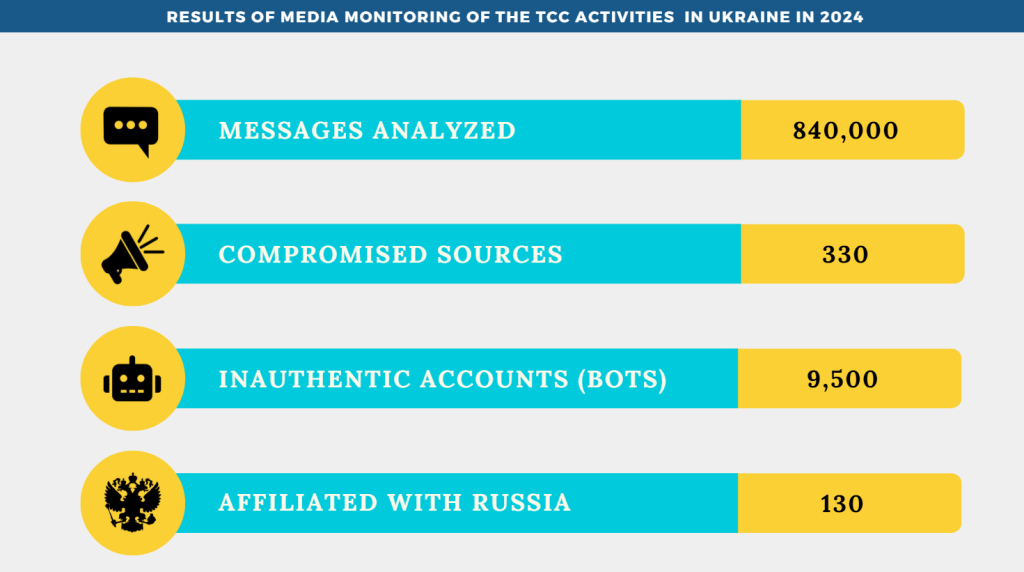
This strategic narrative is what Russian propaganda is trying to promote on Ukrainian social media even during a full-scale war. Since the beginning of 2024, there have been active discussions on the Telegram network (Ukrainian segment) related to Euroscepticism and the promotion of anti-Western narratives.
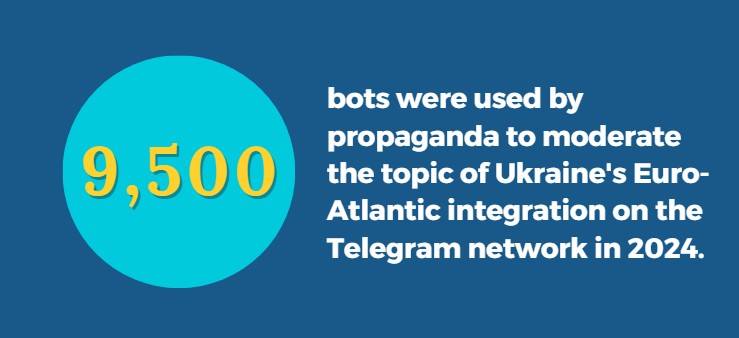
Of the 410,000 relevant messages analyzed, it was found that compromised sources (330), 9.500 bots, and 120 channels affiliated with Russia actively participated in their promotion.
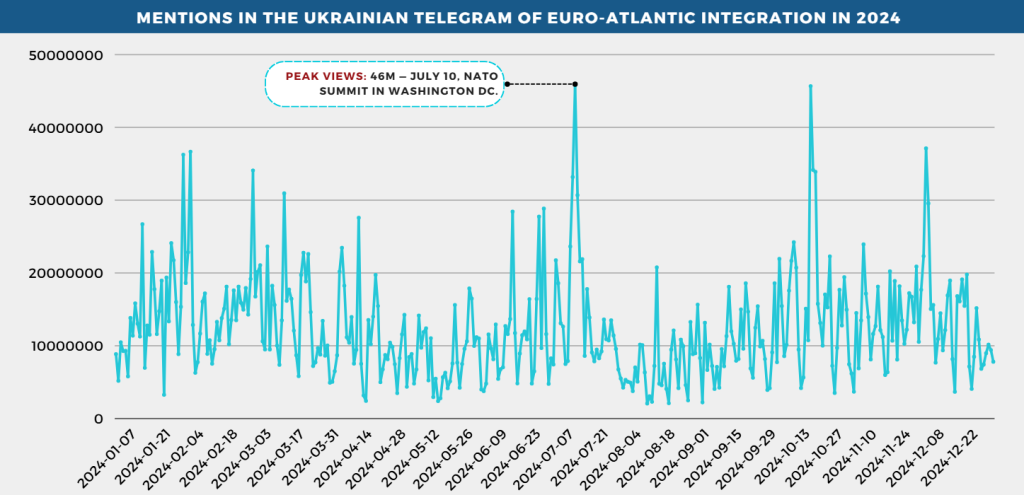
In addition, Ukraine’s Euro-Atlantic path is one of the main topics in the Ukrainian segment of Telegram. Relevant messages garnered almost 4 billion views during 2024, with a peak in viewership on July 10, when the NATO summit was held in Washington. Sentiment analysis shows that these messages received almost 89 million reactions. 17% of them were negative, 6% positive and 77% neutral. In 2025, active discussions continued, with 767 million views in the first quarter.
Bots and influence operations could have affected these public sentiments during the relevant discussions. However, it should be remembered that Russian propaganda has vast experience and fertile ground for its activities.
The most influential narratives, partly based on real feelings one might expect, are: “The West has abandoned us”, “We gave away the third largest nuclear arsenal in the world, and in return we asked only for guarantees of our territorial integrity – even here we were deceived”, “Western companies are not interested in our well-being, they only need our resources and cheap labor,” “ultimately, the European path led us to war and economic collapse.”
2. ULTRA-NATIONALIST, XENOPHOBIC, ANTI-LIBERAL AGENDA
The effort to promote Euroscepticism and reduce support for integration processes will be linked to another process – the efforts of Russian propaganda to play on xenophobia, intolerance and anti-liberal sentiments. This allows propagandists to portray the so-called “European values” as having unacceptable components to Ukrainian citizens. Along with spreading Euroscepticism among Ukrainians, this allows for the spread of “Ukrainian skepticism” among European officials and decision-makers: that Ukraine is not ready for integration and will not be ready for a long time because of intolerance. It will also facilitate influence operations within EU countries to discredit Ukraine among local politicians and societies.
At the moment, Russian propaganda is not paying much attention to systematically promoting these narratives. However, we can expect an intensification of the use of this topic with the beginning of the election campaign.
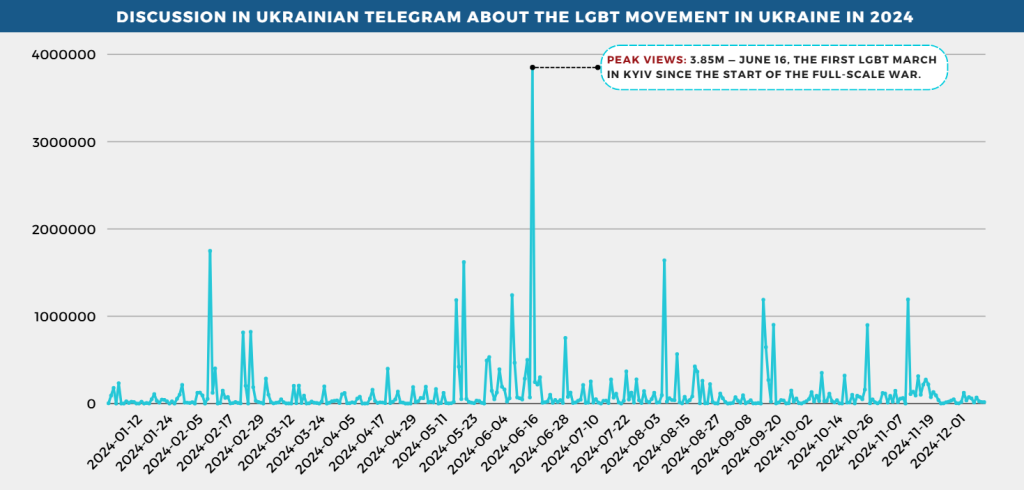
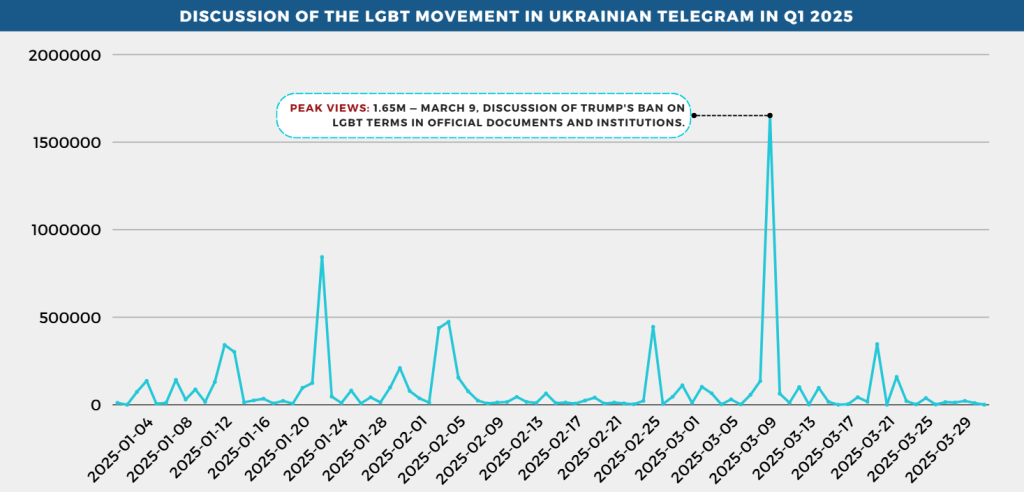
The most obvious topic for manipulation by Russian propaganda is the topic of LGBT rights and their marches. Even during the war, it has received quite a lot of views in the Ukrainian segment of Telegram.
Discussions in the Ukrainian segment of Telegram about the LGBT movement attracted over 46.7 million views in 2024. The peak of views (3.85 million) occurred on June 16, when the first LGBT march was held in Kyiv since the start of the full-scale war.
Sentiment analysis shows that in total, over the past year, these messages have generated almost a million reactions: 15% were negative, 3% positive, and 82% neutral. In 2025, the number of views of relevant messages in the first quarter was more than 8 million.
This data demonstrates a high level of public interest in the topic and a relatively low emotional polarization of discussions. At the same time, the predominance of negative reactions over positive ones indicates an ambiguous attitude towards the LGBT movement in Ukrainian society, which creates the prerequisites for possible provocations. This emphasizes the need for further analysis of factors that influence the formation of public opinion, in particular the role of the media and foreign information manipulation and interference (FIMI).
3. MANIPULATION OF THE PROBLEM OF CORRUPTION
The issue of corruption consistently sparks strong reactions and active debate in Ukrainian society.
The issue of corruption is very prominent in Ukrainian society and is often used to describe many aspects of public life in the country. It provokes active discussions even during the war.
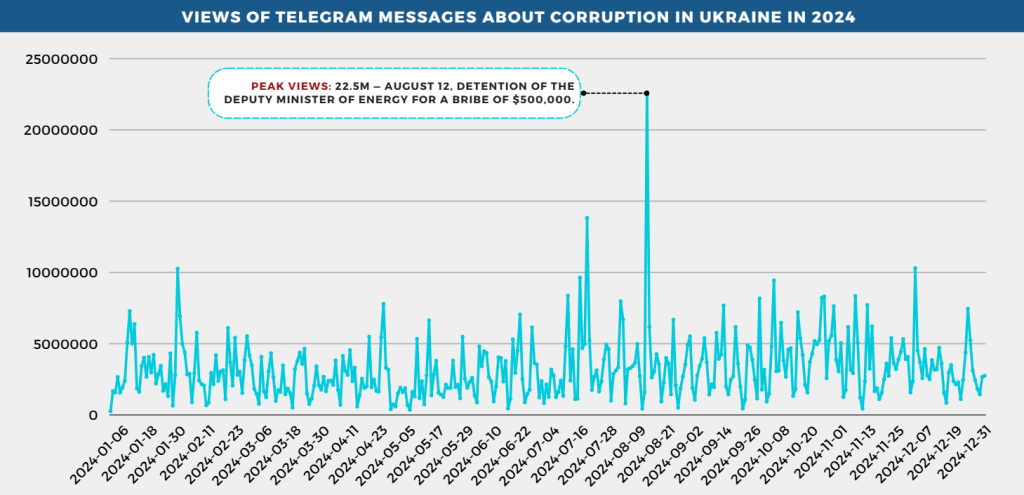
In the Ukrainian segment of Telegram, relevant messages received over 1 billion views in 2024. Sentiment analysis recorded 18.6 million reactions – 33% negative, 1% positive, and 66% neutral.
The peak of views (22.5 million) was recorded on August 12, when the Deputy Minister of Energy was detained for accepting a bribe of $500,000.
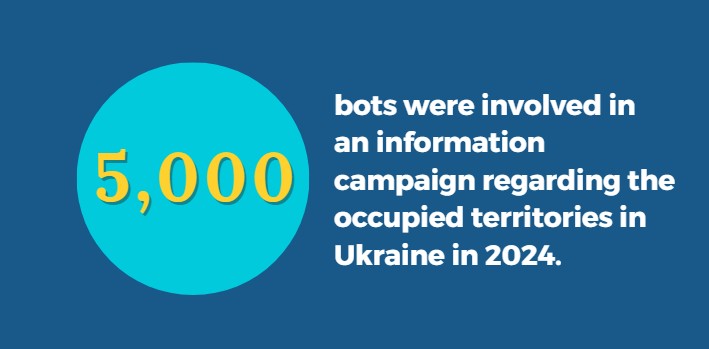
The information campaign involved almost 9,000 bots and 320 compromised sources, including 120 affiliated with the Russian Federation.
According to years of sociological research, Ukrainians are convinced that the government at various levels is corrupt, and this is one of the main reasons for distrust in it. At the same time, they consider elite corruption to be the main problem, not everyday corruption, in which they themselves may be involved, and they pay a lot of attention to it.
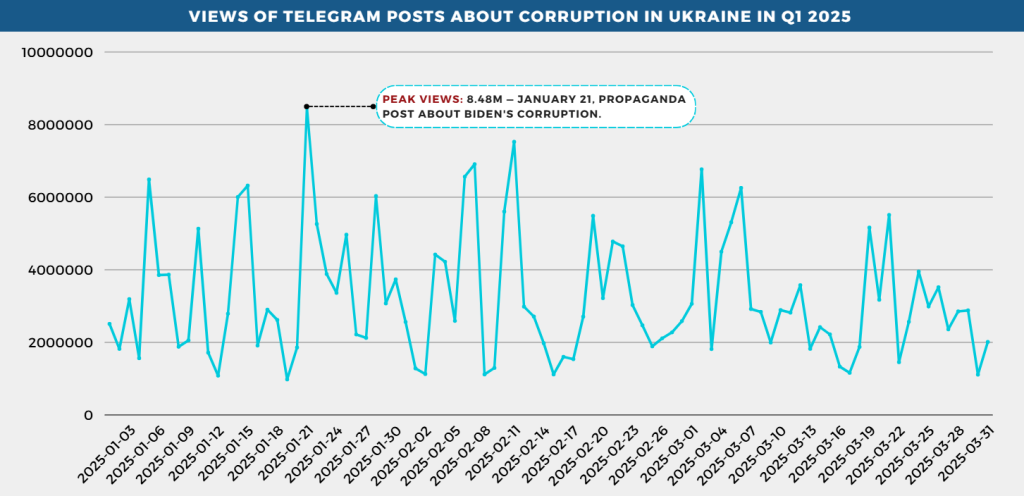
The issue of corruption, in addition to its real component, will become one of the main topics of Russian propaganda in its efforts to influence the electoral process – this applies to both presidential and parliamentary elections. It will also be used to promote Ukrainian scepticism in the EU, the UK, and the United States to undermine support from allies and possible programs for the reconstruction of Ukraine.
In 2025, active discussions on the issue of corruption continued in the Ukrainian segment of Telegram. In particular, the number of views of relevant messages in the first quarter was 291 million.
4. DISCREDITING TOP OFFICIALS TO DEPRECIATE THE RESISTANCE
The current hot phase of the war, in the absence of new full-scale attacks by the Russian Federation, will become a cultural trauma and the central political myth of the Ukrainian nation. Obviously, the Holodomor could not become such a myth in 1991-2014, and the myth of victory in World War II could no longer be the central myth of Ukraine, as it played this role for the Soviet Union and is now used in that way by the modern Russian Federation. Therefore, the efforts of Russian propaganda to undermine the authority of the military-political leadership of Ukraine in order to discredit the Ukrainian resistance from the very beginning of the full-scale invasion have much more far-reaching goals. By discrediting specific representatives of the country’s military-political leadership, it will try to downplay the importance of these events and reduce them to the level of decisions of a few individuals from Ukraine and Western countries.
Attacking specific pro-Western politicians is a common approach of Russian propaganda – we have seen this in Moldova and Georgia. However, attacks on the military-political leadership of Ukraine have even more goals and are even more important. They will reach maximum intensity during the election campaign. Such attacks are already happening systematically. One of the main narratives is the alleged illegitimacy of Volodymyr Zelensky.
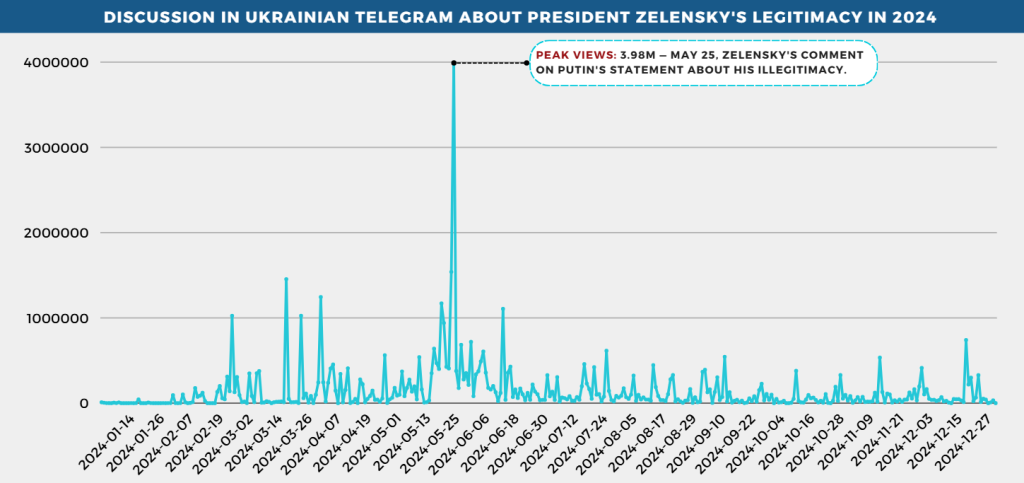
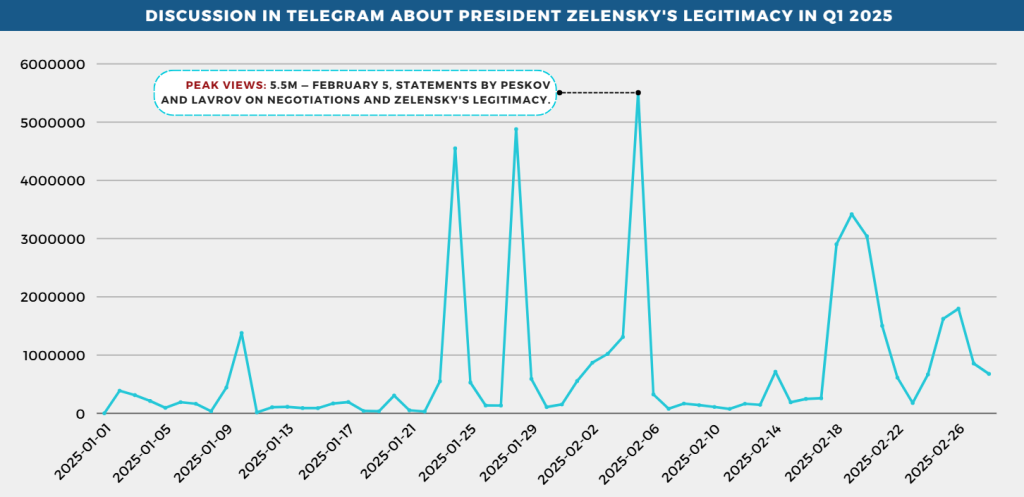
Russian propaganda has tried to provoke such discussions in Ukrainian society. Putin personally participated in this campaign, constantly stating that he does not consider Volodymyr Zelensky a legitimate president. These messages have received 52 million views and 775,000 reactions – 40% negative, less than 1% positive, and 60% neutral in 2024. In the first quarter of 2025 alone, the number of views of relevant messages had already exceeded 52 million.
Overall, narratives about Volodymyr Zelensky’s illegitimacy have not been successful. According to sociological surveys, including those conducted in early 2025, the majority of Ukrainian citizens believe that elections should be held only after the end of hostilities and a stable peace, and therefore Volodymyr Zelensky should remain president until the end of martial law.
It is highly likely that Volodymyr Zelensky will be discredited through accusations of corruption and claims that he failed to avert a full-scale invasion through diplomatic methods.
The main goal of these efforts will be not only to discredit a specific figure, but also to desacralize the heroic resistance of Ukrainian citizens during the invasion and their struggle during the hot phase of the Russian-Ukrainian war. On the other hand, they aim to shift the blame for waging an aggressive war with the Russian Federation onto the military-political leadership of Ukraine, which “caused” such actions by Russia.
5. DIVIDING OF SOCIETY Over PARTICIPATION IN WAR
Russia is actively using any opportunity to deepen social polarization, which creates serious risks for the electoral process.
This topic is already being actively used by Russian propaganda. At the current stage, the primary objective of this approach is to disrupt mobilization efforts and the very ability of the country to resist an attack in the kinetic dimension. In addition, for obvious reasons, a passionate part of society has already joined the Defense Forces of Ukraine. Some of those who have not yet done so clearly need different incentives than those that existed in the early days of the full-scale invasion. Therefore, when the need arose to replenish the Armed Forces with personnel, the state resorted to the centuries-old method of forced mobilization.
This topic is one of the main topics of discussion on social networks. For example, a discussion in the Ukrainian segment of Telegram about Territorial Centers of Recruitment (TCRs) in 2024 garnered about 6 billion views.
The peak of views (59 million) was recorded on October 12 after the Territorial Centre of Recruitment raid at the Okean Elzy concert. Sentiment analysis: 97 million reactions. Of these, 54% are negative, 4% are positive, and 42% are neutral.
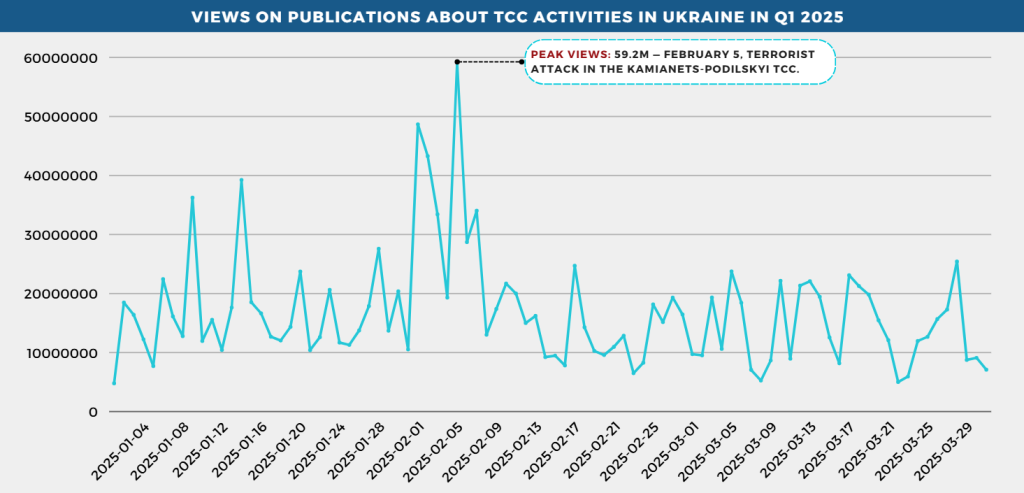
After the start of the election campaign, the criterion of participation and non-participation in the war will be brought into the public sphere in order to strengthen this split for political purposes, which Russian propaganda will undoubtedly take advantage of. There is no doubt that this criterion will play a significant role in the political race, so all potential players are already negotiating with famous military figures to attract them to their team.
Active discussions of the TCR’s activities on Telegram continued in 2025. The number of views exceeded 36 million, and the number of reactions reached 1.2 million.
6. MANIPULATION OF LANGUAGE ISSUE
The language issue is traditionally used by Russia to interfere in Ukraine’s internal political processes and as a tool to influence elections.
The issue of the Russian language has been one of the central themes in Russia’s attempts to influence Ukraine’s domestic and foreign policy for three decades after the collapse of the USSR.
It is no coincidence that after the start of the full-scale invasion, Russia demanded state status for the Russian language in an ultimatum.
Among the main Russian narratives is the oppression of the Russian-speaking population of Ukraine. This narrative is one of the main justifications for the full-scale Russian attack, and was previously used to justify the annexation of Crimea and the occupation of parts of the Donetsk and Luhansk regions.
Being Russian-speaking is directly and indirectly defined by Russian propaganda as belonging to the Russian people, and this leads to the denial of Ukrainian identity and nationality. This argument is used for an internal Russian audience – Russian speakers (and therefore Russians) were oppressed, so one of the goals of the “SMO” is to prevent the “Kyiv regime” from doing this.
This is also used for an external audience and the emphasis is placed on Ukraine’s violation of human rights, in particular the rights of national minorities.
The third important audience for this narrative is Ukrainian society itself and it is used in an attempt to divide it along linguistic lines. These attempts have been going on for over twenty years.
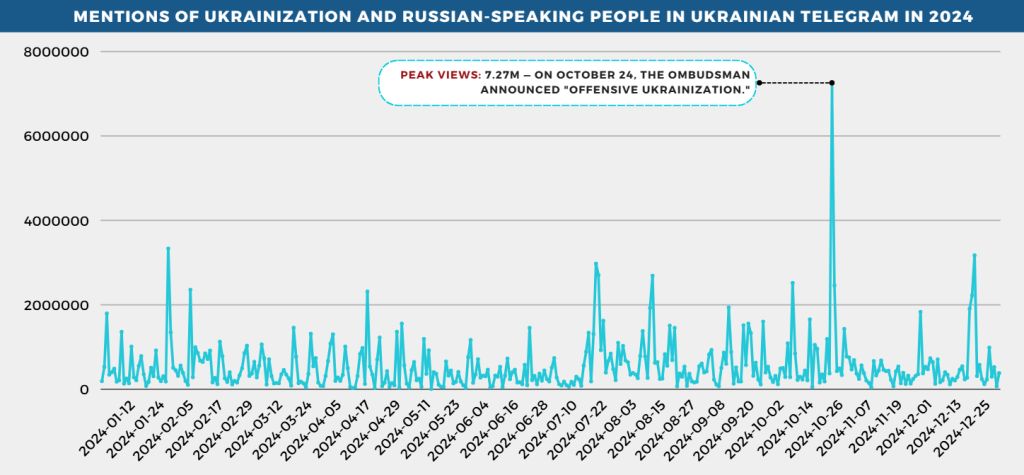
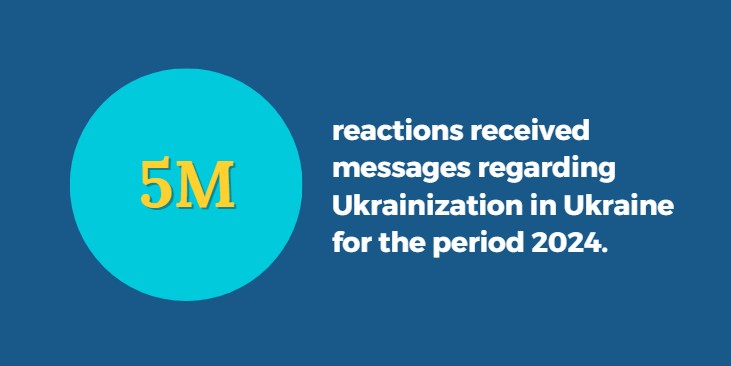
Russian propaganda will undoubtedly actively use this tool during a hypothetical election campaign in Ukraine. It is important to emphasize that Russian propaganda has not stopped doing this even during the war. Discussions in the Ukrainian segment of Telegram regarding Ukrainization and the Russian language in 2024 gained 178 million views.
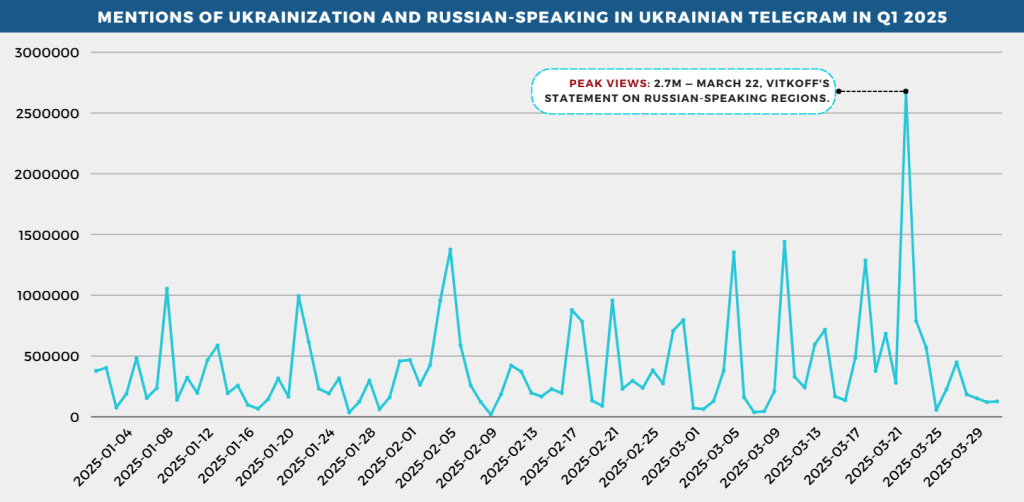
Active discussions on Ukrainization on Telegram continued in early 2025. The number of views of relevant messages in the first quarter exceeded 36 million.
7. DIVIDING OF SOCIETY ON THE CHURCH ISSUE
Russia actively supports the Moscow Patriarchate in Ukraine, which contributes to the division of religious communities and may lead to an escalation of conflicts on religious grounds.
Russian propaganda will also actively use the church issue during a hypothetical election campaign in Ukraine. It is trying to replace the church issue with a religious one, talking about the oppression of the Orthodox by the Ukrainian authorities. Although, in reality, this is not a ban on the Orthodox faith, but rather on a religious structure subordinate to the Russian Orthodox Church. The ban on the activities of this structure was caused by its use by the Russian Federation in the war against Ukraine.
Russia’s emphasis on the issue of the functioning of the Moscow Patriarchate Orthodox Church demonstrates the importance of this tool for it. Just as with the issue of the use of language, or rather its weaponization, the issue of the functioning of the Moscow Patriarchate Church is used for multiple purposes and is aimed at multiple audiences.
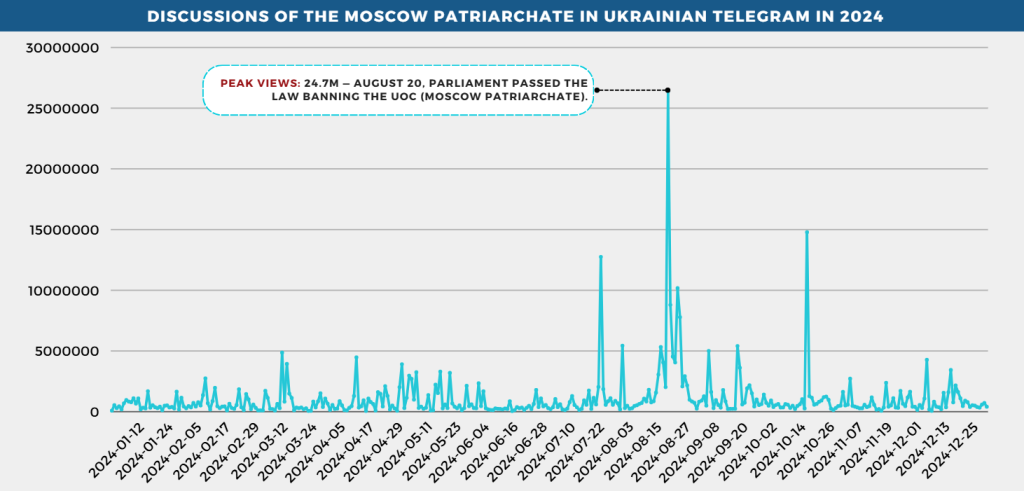
First, it is one of the justifications for the attack on Ukraine for the Russian population. Russian propaganda is trying to attract religious Russians to greater support for the war and personal participation in it by explaining that it is about defending the Orthodox faith and generally about fighting “Satanism.”
For an external audience, this topic is primarily used to attempt to counteract Ukraine’s European integration and strengthen scepticism toward Ukraine in European countries and the United States, presenting it as a country where religious oppression and violations of freedom of conscience occur.
The topic of the Moscow Patriarchate Church began to become relevant after 2014, with the beginning of the kinetic confrontation between Russia and Ukraine, and entered an active phase after the Orthodox Church of Ukraine received the Tomos. With the beginning of the full-scale war and the ban on the UOC Moscow Patriarchate, Russian propaganda pays a lot of attention to this issue.
In 2024, discussions in the Ukrainian segment of Telegram regarding the Moscow Patriarchate totaled over 322 million views. At the beginning of 2025, active discussions of the UOC issue in the Ukrainian segment of Telegram continued. The number of views of relevant messages in the first quarter exceeded 55 million.
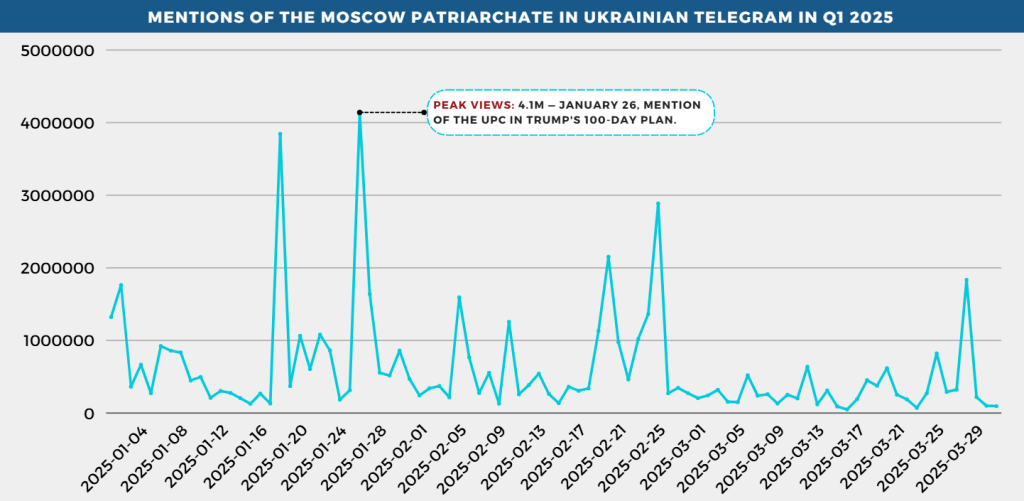
8. SPECULATION REGARDING OCCUPIED TERRITORIES
Speculation about the status of the occupied territories undermines trust in the Ukrainian authorities, provokes internal disagreements, and discredits diplomatic and military efforts to liberate them.
As shown in the first chapter, manipulating the topic of occupied territories is a universal tool of Russian propaganda, which it has used and is using in Moldova and Georgia.
This topic was also actively used during 2014–2022 in Ukraine; now Russia continues to use it in its operations of influence.
Especially since this has become even more relevant for millions of Ukrainians who have lost their homes and whose families have been separated since 2022.
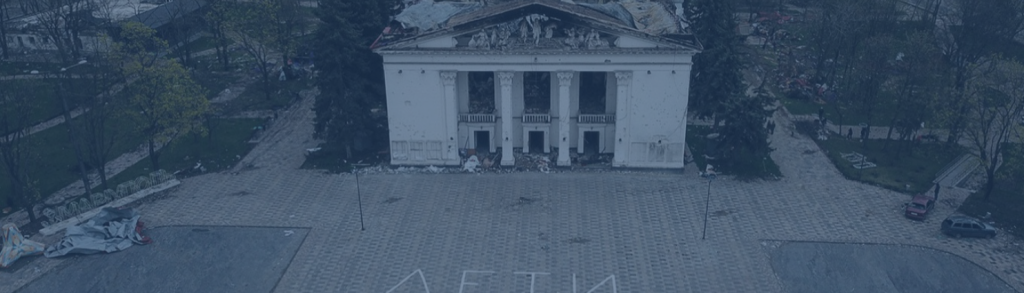
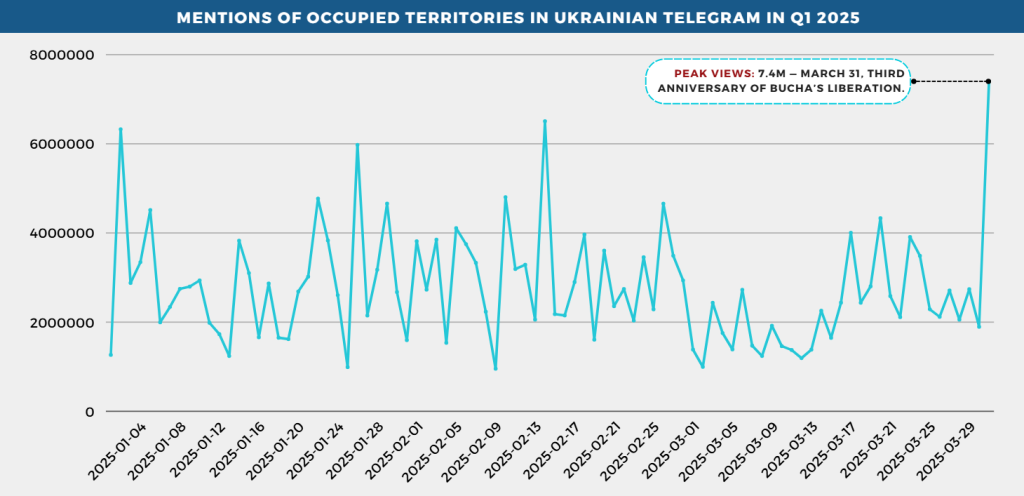
Discussions in the Ukrainian segment of Telegram regarding temporarily occupied territories in 2024 gained almost a billion views.
This topic, with certain restrictions compared to the period 2014-2021, will be used by Russian propaganda. This is because the threats manipulated by Russian propaganda and pro-Russian politicians regarding the occupied territories have already been implemented by Russia – it has carried out a full-scale attack and “wrote” these territories into its Constitution, cutting off its path to voluntary liberation or liberation in exchange for concessions from Ukraine.
Nevertheless, in a limited form, Russian propaganda and certain Ukrainian political actors will continue using these narratives in the election campaign to undermine social cohesion.
Active discussions of TOT-related topics on the Telegram network continued in early 2025. The number of views of relevant messages in the first quarter amounted to 249 million.
9. THREAT OF A NEW FULL-SCALE INVASION
This tool will most likely be used by Russia during the election campaign in Ukraine. We assume that the elections will take place at least a few months after the actual cessation of full-scale hostilities and the shelling of Ukrainian territory with drones, missiles, and guided bombs.
In such a scenario, armed provocations, troop maneuvers, and demonstrative actions by the Russian army will be aimed at influencing the opinion of Ukrainian voters, increasing or decreasing the chances of individual candidates and/or political parties during the electoral process.
This risk is even more significant for a hypothetical election in Ukraine compared to the Russian propaganda approaches used during the elections in Georgia and Moldova, since the memory of the great war will be fresh and the fear of its repetition will be even more acute. Especially after a short period of relative calm and attempts by Ukrainian citizens to establish a peaceful life.
10. BLURRING RESPONSIBILITY: RESTORING NON-POLITICAL AND RELIGIOUS CONNECTIONS
Russia has considerable experience in using non-political methods to achieve political goals. This includes systematic and well-resourced “cultural diplomacy,” the use of sports, museum activities, various exhibitions, and, of course, the use of church ties. That is why the issue of banning the activities of the UOC-MP occupies such an important place in Russian propaganda, because it deprives Russia of a significant set of tools for establishing unofficial ties with Ukraine.
This approach cannot be used during the active phase of the war. However, with the cessation of hostilities and the start of the election campaign, one should expect active efforts to establish connections “between people”. This tool has great potential for Russian propaganda, as it will also be aimed at denying the Russian Federation’s attempts to destroy the Ukrainian nation through an aggressive war and shifting its causes to certain disagreements between abstract politicians.
Meanwhile, cultural, scientific, civil society and religious figures on both sides will demonstrate understanding of the need for dialogue that will put the entire list of Russian war crimes against Ukraine out of brackets.
11. LOBBYING INTERESTS THROUGH ALTERNATIVE POLITICAL PLATFORMS
The Russian side will most likely use another approach, which is not new, in its attempts to influence the political agenda in Ukraine. This approach is to establish political ties without giving them official, state status. Similar attempts were made before the full-scale invasion by Viktor Medvedchuk, involving French and German parliamentarians, to legitimize his open relations with the Russian ruling “United Russia” party.
During a hypothetical election campaign, such attempts, even with the help of intermediaries like politicians from European countries, are unlikely. However, one can expect attempts to establish close ties with far-right and far-left parties against the backdrop of criticism of liberal values and the spread of Euroscepticism. There is also a high probability of cooperation during the election campaign between individual Ukrainian political actors and/or forces with Viktor Orban’s Hungarian “Fidesz” party and Robert Fico’s Slovak “Kurs – Social Democracy” party.
This tool will be closely related to other described approaches of Russian propaganda to influence hypothetical elections in Ukraine: the spread of Euroscepticism within the country, the spread of Ukrainian scepticism in the EU, the shifting of responsibility for the start and waging of an aggressive war from Russia to the Ukrainian military-political leadership, etc.

12. VOTER BRIBERY BY ORGANIZED NETWORKS
Voter bribery was widely used during election campaigns in Ukraine by various candidates and political forces during the 1990s and 2000s. We cannot claim that it played a decisive role, but it undoubtedly had an impact on the election results.
Russia provided financial resources for the physical bribery of voters during the elections in Georgia and Moldova. It paid particular attention in 2024 to the events in Moldova, because simultaneously with the first round of the presidential elections, the citizens there voted to enshrine the European integration course in the Constitution.
It is worth noting that Russia’s use of voter bribery had more chances in Moldova and Georgia because of their smaller populations. In addition, the Russians had the time and unhindered access to these countries to systematically work on building a network of political bribery – primarily local authorities who worked directly with voters.
After the cessation of hostilities and the announcement of hypothetical elections, Russia will not have as much time to establish a network of bribery in Ukraine. However, it can be expected that the Kremlin will try to target individual political actors or political parties in Ukraine. This will most likely happen through intermediaries in European countries or with the help of the already mentioned political parties representing the ultra-right and ultra-left spectrum.
13. CREATION OF A COORDINATED NETWORK OF CHANNELS ON VARIOUS PLATFORMS
Russia has always invested significant resources in operating and promoting its own media abroad or supporting those that promote pro-Russian narratives. As the media landscape in Ukraine changes, only the forms and types of media in which resources will be invested will change, while Russian propaganda’s efforts to influence Ukrainian elections and the agenda will remain unchanged.
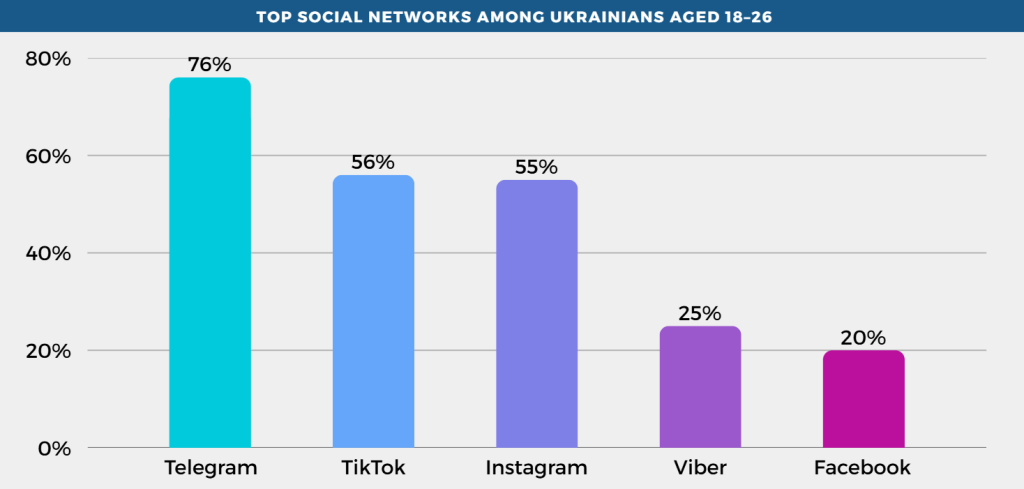
With the loss of importance of traditional media, primarily TV channels, Russian propaganda will use YouTube channels, and for the rapid dissemination of certain narratives – Telegram, TikTok and Instagram platforms. Therefore, during a hypothetical election campaign in Ukraine, one should expect active disinformation measures and influence operations from the Russian side on these platforms.
According to IKAR’s survey among Ukrainian youth aged 18 to 26 in the spring of 2024, the absolute majority named Telegram as their main source of news. TikTok and Instagram were in second and third place, respectively. The effectiveness of these tools for spreading disinformation and manipulating electoral sentiment lies not only in the immediacy of information dissemination, but also in the uncritical perception of this information by consumers in the stream of videos and messages they watch for entertainment or recreation. The Călin Georgescu’s “success” during the elections in Romania confirms these points.
APPROACHES TO REDUCING RUSSIA’S INFLUENCE ON ELECTIONS IN UKRAINE
Developing clear and applied approaches to reducing the influence of Russian propaganda on elections in Ukraine is critical to protecting democracy and the stability of the state. The electoral process must remain free from external interference, as manipulation of public opinion, the spread of disinformation, and the undermining of trust in government are key tools of hybrid warfare.
Effective measures such as media literacy, information threat monitoring, blocking hostile operations, and international cooperation will help society better recognize manipulation and reduce its impact. This will not only protect the electoral process, but also strengthen societal resilience, reduce the risk of destabilization, and strengthen international trust in the election results.
Approaches to reducing malicious Russian influence on elections:
- A detailed and time-bound plan for Ukraine’s EU accession.
- Rapid reconstruction and joint investment projects.
- Assistance from European countries in returning refugees to Ukraine.
- Recognition of the fact that Russia is weaponizing all areas.
1. DETAILED AND DATE-TIED PLAN FOR UKRAINE’S EU ACCESSION
The first approach is, of course, a clear plan for Ukraine’s European integration, since continuing the policy of uncertainty with formal promises like “one day, when all the homework is done,” will most likely lead to the rapid spread of Euroscepticism and ultimately to the “Georgian scenario.”
At the moment, according to all-Ukrainian sociological polls, the EU is the most popular geopolitical choice of Ukrainians – about 88% of citizens support such a course.
The case of Georgia clearly demonstrates what a half-opened door policy leads to. Currently, it is a regime completely loyal to the Kremlin, which de facto came to power before 2024. Last year, it only consolidated its Euroscepticism and began copying Russian authoritarian practices.
The same scenario is quite likely for Ukraine – the growth of Eurosceptics who will talk about pragmatism, in particular in negotiations with the EU, postponing and complicating them. However, later, after entering parliament or becoming president, they will definitely talk about pragmatism in relations with Russia.
It is important to prevent the implementation of the Georgian scenario in Ukraine.
At the same time, Ukraine’s accession to the EU cannot be stretched for a long period of time. Due to military, geopolitical, social, demographic, economic and other factors, this accession should take place over a period of 5-7 years with a defined step-by-step program tied to specific dates.
A clear European perspective will make it possible to counteract active post-war attempts by Russian propaganda and multi-level influence operations at the strategic level to turn Ukraine into a “gray zone,” and then into an analogue of modern Georgia, or in the worst case, Belarus.
Thus, at the tactical level, there will immediately be an opportunity to counteract one of Russia’s most effective approaches to interfering in elections in the post-Soviet space – Euroscepticism, joining the European Union within a foreseeable time frame.
2. RECONSTRUCTION OF UKRAINE AND JOINT LARGE-SCALE PROJECTS WITH THE EU
The economic damage caused by Russia at this stage is quite approximate. Especially since the war continues at the same high pace as in 2024, and attacks using drones, missiles, and guided bombs are only increasing in scale and are carried out by Russia every day. It can only be argued that the economic damage exceeds half a trillion dollars and that Ukraine will need very large resources for reconstruction after the cessation of hostilities.
Under such conditions, large-scale reconstruction of the country and joint investments with European and other partners would be a natural and clear demonstration of Ukraine’s real approach to joining the EU. This would also reduce the potential for Russian operations of influence and disinformation campaigns aimed at interfering in a hypothetical election in Ukraine, where the strategic narrative would be betrayal by the West, and specifically by the European Union.
As the elections in Georgia and Moldova have shown, Russian propaganda actively appeals to economic problems, blaming them on the European integration aspirations of post-Soviet countries.
Ukraine was not and will not be an exception in the future. Especially since the war of attrition without large-scale support and reconstruction assistance from the EU will create fertile ground for this kind of manipulation during election campaigns.

3. ASSISTANCE OF EUROPEAN COUNTRIES IN THE RETURN OF REFUGEES TO UKRAINE
The problem of depopulation was relevant for Ukraine even before the start of the Russian-Ukrainian war in 2014 and, even more so, in 2022. The full-scale invasion brought it to the forefront and made it one of the most acute for the Ukrainian state for the next decades. In addition to the losses in the war and the population that remained in the territories occupied by Russia, today the number of Ukrainian refugees is between 6 and 8 million. Over time, more and more Ukrainian citizens are solving the “refugee dilemma” not in Ukraine’s favor.
However, European countries can contribute to solving this problem. In particular, by reducing aid to refugees and encouraging them to return to Ukraine as soon as the security situation allows. Of course, there are many circumstances that need to be taken into account.
The return of these people should become another factor in the democratic nature of future hypothetical elections in Ukraine. This category of citizens, who experienced the need to leave their country due to Russia’s aggressive war, will also become an additional obstacle to the implementation of the “Georgian scenario” in Ukraine. They are not a guarantee, but rather an important component in this process.
4. CONSIDERING THAT RUSSIA WEAPONIZES ALMOST EVERYTHING
Russian propaganda has a long history of weaponizing non-material spheres, and new media is no exception.
Ukraine has long faced and accepted the fact that Russia uses an approach to advancing its interests called “weaponization.” The roots of this approach lie in the difference between two fundamental concepts: “culture” and “civilization.”
Russia accepts Western technologies as part of its civilization, but has no intention of adopting Western values as part of its culture. Moreover, Russia is trying to use them as a weapon against the countries of Europe and the United States themselves.
Europe and the “collective West” must recognize that Russia, in its malign activities, weaponizes absolutely everything: language, religion, the rights of national minorities, democratic institutions, and, of course, the media and communications. When we recognize that absolutely everything can be used as a weapon, we see much more clearly the attempts of Russian propaganda to interfere in the electoral process.
We can do this using the example of social networks. As already mentioned, according to a survey by the Institute for Conflict Studies and Analysis of Russia in early 2024 – among Ukrainian youth aged 18-26, Telegram is the most popular messenger and source of news. TikTok and Instagram share second place, both significantly exceeding all other messengers and platforms.
We have shown in detail how Russian propaganda uses Telegram for its own purposes and what approaches it is likely to use during a hypothetical election in Ukraine.
It is worth mentioning TikTok, which Russia is also weaponizing. This platform is the second most popular in Ukraine, especially among Ukrainian youth.
Let’s look at a few topics that were actively viewed on TikTok in 2024 and are relevant to our analysis.
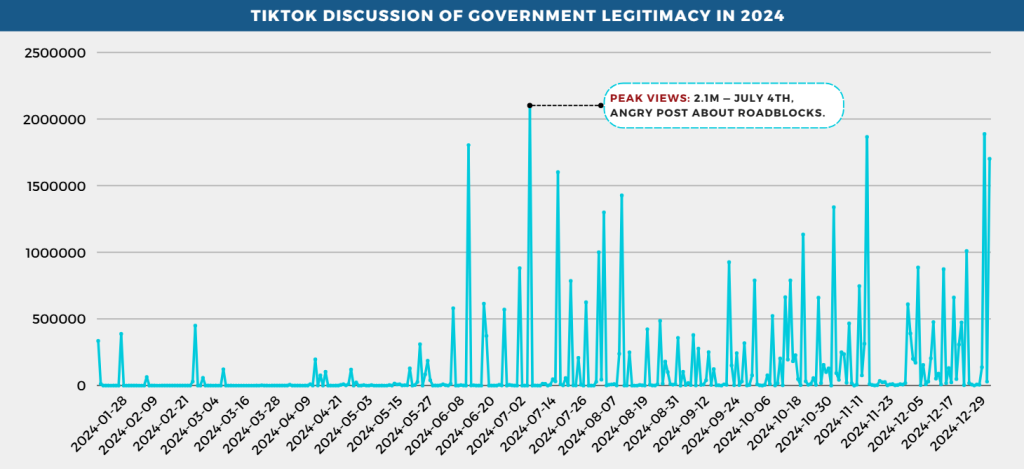
The first is the discussion on Ukrainian TikTok about the legitimacy of President Zelensky in 2024. The total number of views of relevant posts is 44.5 million. This figure was achieved with only 900 posts made by 207 actors.
Peak views: 2.1 million – July 4, angry post about roadblocks.
Sentiment analysis: 2.98 million reactions. 8% negative, 18% positive, 74% neutral.
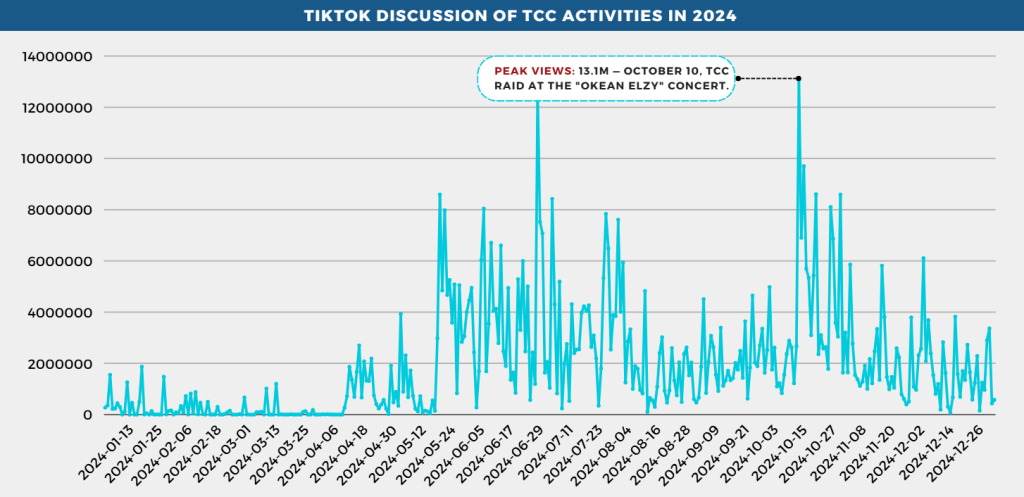
It is worth mentioning the discussions on Ukrainian TikTok regarding territorial recruitment centers (TCC) in 2024. The total number of views of relevant messages was 701 million.
Peak views: 13.1 million – October 10, TCC raid on the “Okean Elzy” concert.
Sentiment analysis: 27.3 million reactions. 19% negative, 3% positive, 78% neutral.
As we can see, even during the most acute period of the war, Russian propaganda pays great attention to these manipulations. They constantly refer to European legislation and the obligations that Ukraine has assumed on its path to the European Union.
During the election campaign, individual political parties and actors will criticize the authorities for violating freedom of speech and freedom of religion. It is very important to avoid a formal approach to these accusations and to take into account the whole picture of hybrid warfare, Ukraine’s previous experience, and Russia’s attempts to interfere in its election campaigns and the campaigns of other countries. This will be extremely important to counter these strategic approaches of the Russian Federation to influence elections and spread scepticism about Ukraine in European countries.

Countering vote-buying networks will be crucial, and these networks will undoubtedly be used in a hypothetical Ukrainian election, including by pro-Russian candidates, as the Kremlin has never spared any money to bribe voters to bring loyal politicians to power. This requires far fewer resources than war and is very effective.
However, even more important during a hypothetical election campaign will be the use of messengers and social networks, as television has greatly lost its role in political campaigning – a process that has been going on for many years, but has accelerated dramatically with the start of the full-scale invasion.
According to IKAR’s long-term media analysis, Russian propaganda actively uses social networks in its information, psychological operations and influence operations. Social networks, due to their popularity, ingrained in the everyday lives of citizens, and their entertainment nature, provide a wide space for this kind of malign activity.
In other words, Ukrainians use them for entertainment and recreation, but ultimately become objects of manipulation for political and military-political purposes. This is especially true of TikTok and Telegram. As numerous examples, such as the 2024 presidential election in Romania, show, there is currently no single universally accepted answer to what to do about manipulation on social media and messengers.
It is obvious that there is a need for general parameters for a mechanism to counter the distortion of the democratic process through social media. It is also obvious that when developing such a countermeasure, one cannot be guided by a formal approach to legislation. Since Russian propaganda often appeals to the protection of human rights in order to destroy these rights, weaponizing what it intends to undermine or completely destroy.