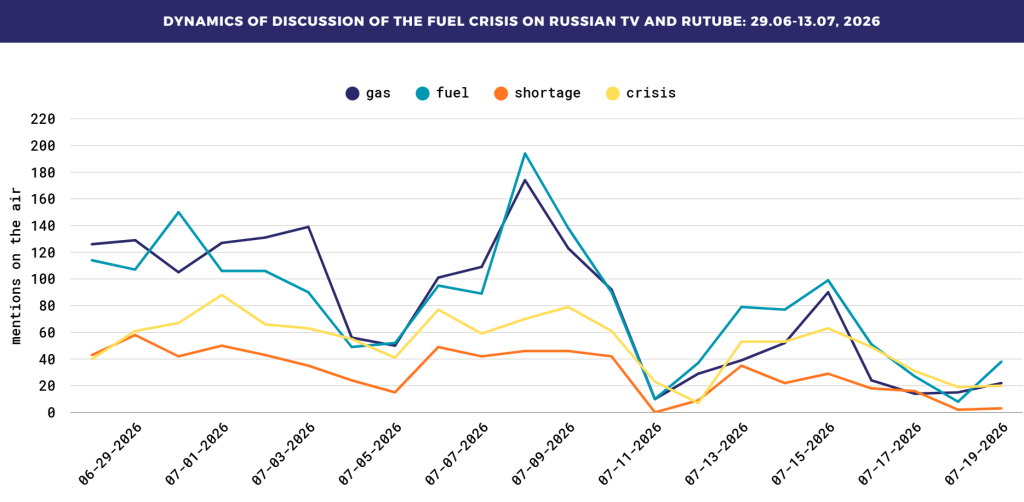
Transformation of the Fuel Crisis into a Systemic Challenge
Monitoring of the Russian information space during the period from 29 June to 20 July 2026 indicates a further escalation of the fuel crisis and its transition from a regional issue into a systemic challenge affecting the Russian Federation’s rear-area support system. While at the end of June fuel shortages were manifested primarily through localized disruptions, particularly in the southern regions and the occupied Crimea, by the first half of July the crisis had evolved into a nationwide problem. Signs of fuel shortages, administrative rationing, and logistical disruptions have been recorded in an increasing number of regions, with their effects spreading across transportation, agriculture, industry, domestic trade, and interregional freight movement.
The defining feature of the reporting period was the growing impact of strikes on Russia’s rear infrastructure on the fuel supply system. Initially, the key factor was the reduction in refining capacity at individual oil-processing facilities. Over time, however, the primary driver became the disruption of logistics chains responsible for transporting, storing, and redistributing petroleum products between regions. As a result, the fuel crisis is increasingly determined not by production volumes but by the declining resilience of the entire rear-area supply system.
The systemic nature of the crisis is also reflected in its expanding geographic scope. Whereas at the end of June shortages and administrative restrictions were concentrated mainly in occupied Crimea, Krasnodar Krai, Rostov Oblast, and Nizhny Novgorod Oblast, by mid-July similar problems had spread across a significant portion of European Russia. Localized shortages are gradually merging into a single crisis space, forcing the federal government to shift from responding to isolated incidents toward managing nationwide processes.
At the same time, the government’s response has evolved. Temporary restrictions on fuel sales, QR code systems, emergency redistribution of reserves, and increased gasoline imports as ad hoc measures are gradually giving way to a centralized crisis-management model. Federal and regional authorities are increasingly relying on centralized resource allocation, special supply regimes for priority consumers, price regulation, and other mechanisms of direct administrative control. This reflects the strengthening of state control over the fuel market.
The economic consequences of the crisis are also becoming more pronounced. Beyond shortages of gasoline and diesel fuel, there are growing disruptions in the execution of government contracts, rising logistics costs, difficulties in supplying the agricultural sector during seasonal fieldwork, reduced activity among transport companies, and mounting inflationary pressure. The fuel crisis is increasingly affecting a broad range of sectors across the Russian economy.
Official information policy has also changed. While the Russian authorities initially avoided acknowledging the systemic nature of the shortages, the growing scale of the crisis has prompted a shift toward partial recognition of the problem while emphasizing that it remains under control and that government measures are effective. The causes of the shortages are increasingly attributed to Ukrainian strikes against energy and transport infrastructure, providing the basis for justifying prolonged administrative restrictions.
Overall, developments during the reporting period indicate that the fuel crisis is evolving into a comprehensive indicator of the resilience of the Russian Federation’s rear infrastructure. Its further development is increasingly determined not only by the physical availability of petroleum products, but also by the state’s ability to maintain logistics chains, ensure interregional redistribution of resources, mitigate the economic effects of strikes, and preserve control over public reactions. This transformation defines a new phase in the evolution of the fuel crisis and will shape its future trajectory.
Southern Regions and Occupied Crimea: The Most Vulnerable Segment of Fuel Logistics
Despite the spread of the fuel crisis across most regions of the Russian Federation, the southern direction remains the most vulnerable element of the country’s fuel supply system. Krasnodar Krai, Rostov Oblast, and occupied Crimea were the first to experience the systemic consequences of logistical disruptions and became testing grounds for administrative mechanisms designed to manage fuel shortages. Approaches first introduced in these regions are now gradually being extended to other parts of Russia.
Occupied Crimea under Permanent Administrative Regulation
The most challenging situation persists on the occupied Crimean Peninsula, where dependence on external fuel supplies, the high concentration of military infrastructure, seasonal growth in demand, and the vulnerability of transport routes combine to create acute supply risks. While administrative restrictions at the end of June were still temporary, during the reporting period they effectively became a permanent feature of the fuel market.
This is illustrated by the reintroduction of the QR code system in Sevastopol following its brief suspension, as well as the expanded use of fuel cards, purchase limits, and special sales procedures. The continued application of these measures, together with the need for additional financial support for the region, confirms Crimea’s dependence on centralized fuel supplies.
At the same time, the principal challenge is no longer the physical availability of fuel but the instability of its supply. Disruptions affecting port infrastructure, tanker logistics, and transport routes through the Sea of Azov complicate deliveries to the peninsula even when sufficient fuel resources are available. Under these conditions, administrative rationing is increasingly being used to compensate for logistical disruptions rather than simply to restrain demand.
Krasnodar Krai at the Center of Logistical Disruptions
Krasnodar Krai remains the principal logistics hub in the southern direction and one of the regions most exposed to the crisis. During the reporting period, long queues at gas stations, supply disruptions, delays in fuel tanker deliveries, and rising fuel prices persisted.
The fuel crisis is exerting an increasingly visible impact on the transport and tourism sectors, reducing road freight volumes and complicating the operations of small logistics companies. At the same time, activity in the shadow market is expanding, including illegal fuel resale and unofficial supply channels, both of which are characteristic of a prolonged fuel shortage.
A further complicating factor is the deterioration of maritime logistics. Difficulties in port operations and increasing risks to shipping in the Sea of Azov are placing additional pressure on road and rail transport, reducing the resilience of the regional supply system.
Concentration of Logistical Risks in Rostov Oblast
Rostov Oblast remains one of the key transport hubs linking Russia’s central regions with the occupied territories of Ukraine. The combination of intensive military and civilian logistics makes the region particularly vulnerable to disruptions in fuel supply.
During the reporting period, fuel shortages were accompanied by growing difficulties for civilian transport operators, rising transportation costs, and a decline in interregional freight traffic, negatively affecting industry, agriculture, and domestic trade.
At the same time, administrative control over fuel distribution has intensified. Priority is increasingly given to strategic consumers, while the civilian sector is forced to operate under growing resource constraints, reflecting the adaptation of the fuel supply system to wartime requirements.
The Southern Direction as an Indicator of the Crisis
Developments in southern Russia illustrate trends that subsequently spread to other regions of the country. It was here that QR codes, fuel cards, purchase limits, centralized resource allocation, and priority supply for selected categories of consumers were first implemented on a large scale. These mechanisms are now gradually being incorporated into nationwide practice.
Recent developments confirm that the defining factor behind the fuel crisis is no longer limited to reduced petroleum product output but increasingly stems from disruptions to the transport and logistics system. The declining resilience of supply routes, growing pressure on alternative delivery channels, and the need for centralized redistribution of resources are becoming the principal determinants of the effectiveness of the Russian Federation’s rear-area support system.
Transition to Systemic Destabilization of Logistics
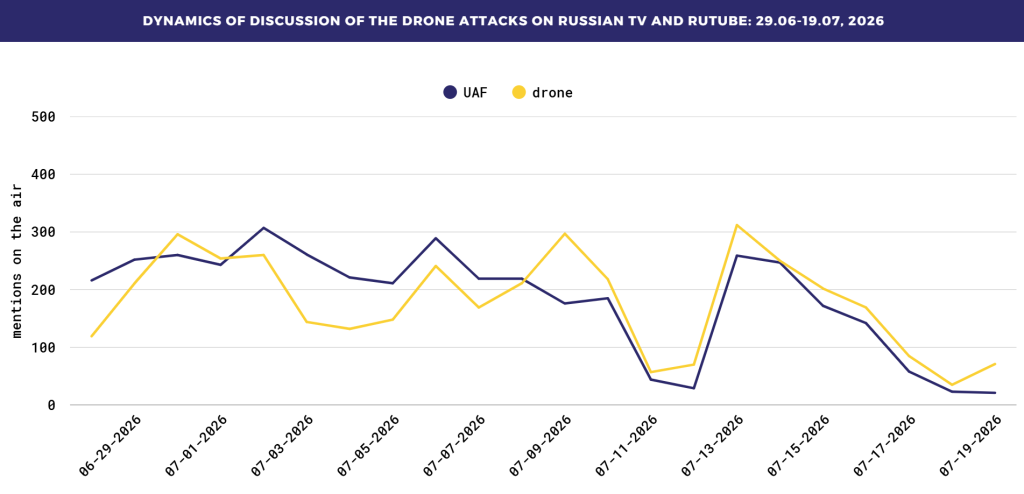
Analysis of developments during the period 29 June–20 July 2026 indicates a shift in the nature of the campaign targeting the Russian Federation’s rear infrastructure. Whereas the initial phase focused primarily on oil refineries, tank farms, and fuel storage facilities to reduce petroleum product output, the reporting period demonstrates a transition toward a comprehensive effort to disrupt the entire fuel supply system—from production and storage to transportation, transshipment, and the interregional distribution of resources.
The initial stages of the campaign were aimed at limiting the production capacity of Russia’s oil refining sector. However, subsequent developments have shown that even where refinery operations are partially restored, the critical factor remains the continuity of logistics and the ability to deliver fuel to end users.
Against this backdrop, strikes on transport and logistics infrastructure have assumed increasing importance. During the reporting period, fuel depots, logistics hubs, industrial enterprises, and warehouse complexes supporting the accumulation, storage, and distribution of material resources came under attack. Particularly notable were fires at major logistics facilities in Moscow and Tambov oblasts, highlighting the vulnerability not only of the fuel supply network but also of Russia’s broader rear-area support system.
A separate line of effort is the growing pressure on maritime logistics. Disruptions to shipping in the Sea of Azov, attacks on the tanker fleet, and the need to reroute supply chains have complicated fuel deliveries to southern Russia and occupied Crimea while simultaneously increasing the burden on road and rail transport. As a result, supply disruptions are becoming more frequent even in regions that have not been directly targeted.
At the same time, strikes on transport and energy infrastructure supporting logistics networks have become increasingly significant. Damage to individual facilities complicates coordination between producers, carriers, and consumers, amplifying the effects of attacks on the oil refining sector.
A defining feature of the reporting period has been the widening geographic reach of the consequences. Whereas fuel shortages were previously concentrated in regions where fuel and energy infrastructure had been directly targeted, they are now increasingly driven by disruptions to interregional logistics and the limited capacity to rapidly redistribute resources across the country.
In response, the Russian authorities have been forced to simultaneously restore damaged infrastructure, reorganize logistics networks, rely on alternative transport routes, and centrally coordinate fuel distribution. These efforts require additional financial and organizational resources, increase the burden on the state administration system, and reduce its overall adaptability.
Overall, developments during the reporting period point to a qualitative shift in the nature of the strike campaign. Its principal effect is no longer confined to reducing petroleum product output but extends to the comprehensive destabilization of the rear-area support system, encompassing production, storage, transport and port infrastructure, warehouse networks, and interregional logistics. Under these conditions, fuel shortages represent only one manifestation of the broader decline in the resilience of the Russian Federation’s transport and economic infrastructure. The cumulative impact of the strikes is increasingly reflected in systemic disruptions to logistics chains that constrain the state’s ability to maintain stable resource flows and mitigate the effects of a sustained campaign against its rear infrastructure.
Administrative Response: From Crisis Measures to a Model of Centralized Management
One of the key trends during the reporting period was the intensification of administrative regulation of the Russian Federation’s fuel market. Analysis of developments indicates that federal and regional authorities are gradually moving away from market-based mechanisms for balancing supply and demand in favor of centralized control over the production, distribution, and consumption of petroleum products. Whereas such measures were previously largely ad hoc, they increasingly became part of a systematic governance model during the reporting period.
Centralization of Resource Allocation at the Federal Level
The deepening fuel crisis has compelled the federal government to shift from localized responses to centralized management. Government agencies have stepped up their activities, and interagency coordination has intensified with the participation of profile ministries, the Federal Antimonopoly Service, and representatives of the fuel and energy sector. At the same time, the government adjusts export policy, expands state support mechanisms, temporarily relaxes selected technical fuel standards, and introduces additional market stabilization measures.
The main trend was the centralization of resource allocation. The federal government is assuming an increasingly active role in coordinating the interregional redistribution of fuel, defining priority supply routes, and ensuring deliveries to strategically important sectors, particularly transportation and agriculture. This reflects a shift toward treating fuel supply as a component of the state’s strategic resilience.
Institutionalization of Rationing at the Regional Level
The most visible changes are taking place at the regional level, where temporary restrictions are being replaced by permanent mechanisms for controlling fuel distribution.
Regional authorities introduced fuel cards, QR codes, purchase limits, license plate-based sales, fuel inventory monitoring systems, and priority supply arrangements for selected categories of consumers. At the same time, they intensified oversight of filling stations, transport operators, and fuel suppliers, while in some cases law enforcement agencies helped maintain order.
The situation in occupied Crimea remains the clearest example of this trend. The reintroduction of QR codes after their brief suspension demonstrates that administrative rationing has evolved from a temporary emergency measure into a permanent instrument for managing fuel shortages.
Emergence of a Long-Term Governance Model
Administrative decisions taken during the reporting period indicate a broader shift in the state’s approach to crisis management. Whereas government policy previously focused on responding to localized supply disruptions, it now increasingly focuses on operating under conditions of prolonged shortages and recurring logistical disruptions.
This shift is reflected in the expansion of government authority over resource allocation, tighter administrative control, and the introduction of priority supply regimes for selected sectors of the economy and categories of consumers. At the same time, the federal government is assuming a progressively larger role in coordinating the interregional redistribution of fuel, underscoring the continuing centralization of governance.
Overall, developments during the reporting period indicate the emergence of a stable administrative model for managing the fuel market, adapted to conditions of sustained disruption to the transport and logistics system. If current trends persist, centralized resource allocation and administrative rationing are likely to remain the principal instruments of state policy in the field of fuel supply.
Legitimizing Administrative Restrictions and Shaping the “Economic Defense” Narrative
Alongside the deepening fuel crisis and the expansion of administrative regulation, the Russian authorities’ information policy has also evolved. Whereas the initial communication strategy focused on minimizing public attention and denying the systemic nature of the problem, the reporting period reflects a shift toward controlled acknowledgment of the crisis, accompanied by efforts to legitimize administrative restrictions.
From Denial to Controlled Acknowledgment
Initially, fuel shortages were attributed to localized technical disruptions, seasonal increases in demand, or the actions of individual market participants. Federal authorities and state media emphasized the adequacy of strategic reserves and the government’s ability to stabilize the situation quickly, while avoiding any recognition of the crisis as systemic.
However, as shortages spread and administrative restrictions were repeatedly reintroduced, this approach became increasingly untenable. Official rhetoric shifted accordingly: isolated problems with fuel supply began to be acknowledged publicly, while consistently emphasizing that the situation remained under control and that the state possessed sufficient resources to restore stability.
Constructing an External Explanation for the Crisis
During the reporting period, the authorities increasingly attributed the fuel crisis to Ukrainian strikes on Russia’s energy and transport-logistics infrastructure. Whereas this factor was previously mentioned only sporadically, it became the principal explanation for fuel shortages, logistical disruptions, and the need for administrative restrictions.
At the same time, official messaging placed growing emphasis on the restoration of damaged facilities, the work of emergency response services, and the uninterrupted functioning of critical infrastructure, reinforcing the image of a state capable of maintaining control despite external pressure.
Legitimizing Administrative Restrictions
An important component of the information campaign was to normalize administrative regulation. QR codes, fuel cards, purchase limits, and priority fuel allocation for selected categories of consumers are increasingly presented not as exceptional emergency measures, but as necessary instruments for maintaining the functioning of transportation, agriculture, and other critical sectors.
At the same time, information support for the activities of federal and regional authorities intensified. Regular reporting on government decisions, additional fuel deliveries, and measures to support affected regions reinforces the perception of continuous state oversight and effective crisis management.
Control of the Information Space
Alongside promoting the official narrative, the authorities have intensified efforts to counter information that could undermine confidence in state governance. This includes public rebuttals of reports concerning the scale of fuel shortages, official explanations for administrative restrictions, and stronger coordination between federal and regional authorities to ensure a unified communication strategy. Authorities paid particular attention to local incidents that could trigger panic buying or increase public dissatisfaction.
Main Trend
Developments during the reporting period indicate a transition from reactive responses to individual reports toward a systematic information strategy supporting crisis management. Information policy is becoming increasingly integrated with administrative decision-making, providing public legitimacy for restrictive measures while reinforcing the narrative that the situation remains under control.
Under these conditions, the Russian authorities increasingly view the fuel crisis not only as an economic or logistical challenge but also as a factor affecting domestic political stability. Accordingly, information management becomes one of the central elements of the broader crisis response system, intended to preserve public confidence and secure acceptance of administrative restrictions.
Crisis Dynamics and Outlook
Analysis of developments during the period 29 June–20 July 2026 indicates that the fuel crisis in the Russian Federation has entered a new phase. Whereas its initial manifestations were limited to localized disruptions at individual oil refineries and fuel supply problems in specific regions, during the reporting period it evolved into a systemic fuel and logistics crisis affecting transportation, the economy, public administration, and information policy.
Key Trends
The fuel crisis is assuming a nationwide character. Fuel shortages, supply disruptions, and administrative restrictions are spreading to an increasing number of regions, indicating the emergence of a unified crisis environment and highlighting the growing importance of fuel supply for the functioning of Russia’s transport system and broader economy.
The transport and logistics system becomes the primary target of disruption. Alongside attacks on oil refining capacity, strikes against logistics infrastructure—including fuel depots, warehouse complexes, transport hubs, port infrastructure, and maritime supply routes—are more frequent. As a result, the resilience of the fuel supply system is increasingly determined by the effectiveness of logistics rather than by production capacity.
Administrative regulation is replacing market mechanisms. The federal government is strengthening centralized resource allocation, expanding fuel rationing, prioritizing supplies to critical consumers, and tightening state control over the market, reflecting a transition toward an administrative model of fuel supply management.
The crisis is exerting a growing impact on the civilian economy. Logistics costs are increasing, contract fulfillment is becoming more difficult, regional imbalances are deepening, and inflationary pressures are intensifying, indicating that the consequences of the fuel crisis now extend well beyond the energy sector.
Information policy becomes an integral part of crisis management. The Russian authorities shifted from denying the existence of systemic problems to acknowledging fuel shortages in a controlled manner, while simultaneously legitimizing administrative restrictions and linking them to the effects of Ukrainian strikes on rear-area infrastructure.
Likely Developments
If the current intensity of strikes is maintained, the most likely developments include:
- further expansion of administrative rationing across the fuel market, including the extension of QR code systems, fuel cards, and purchase limits to additional regions;
- stronger centralized management of interregional fuel distribution and an expanded state role in the functioning of the fuel market;
- a widening imbalance between military and civilian consumers in favor of sectors associated with the defense-industrial complex, transport infrastructure, and security services;
- continued expansion of the shadow fuel market as a consequence of prolonged administrative regulation and uneven regional fuel supply.
Overall Assessment
The fuel crisis is increasingly determined not by the volume of petroleum product output but by the resilience of the transport and logistics system and the state’s ability to sustain the interregional redistribution of resources under conditions of sustained external pressure. At the same time, its development is accompanied by greater centralization of governance, expanding administrative control, and the integration of information policy into crisis response mechanisms.
The fuel crisis has therefore evolved from a sector-specific problem into a comprehensive indicator of the resilience of the Russian Federation’s rear-area support system. The future trajectory of the crisis over the medium term will depend primarily on the effectiveness of logistics, the state’s ability to compensate for structural imbalances, and its capacity to maintain centralized control over resource distribution.