Monitoring Russian Narratives Regarding Moldova: 21-27.04.2025

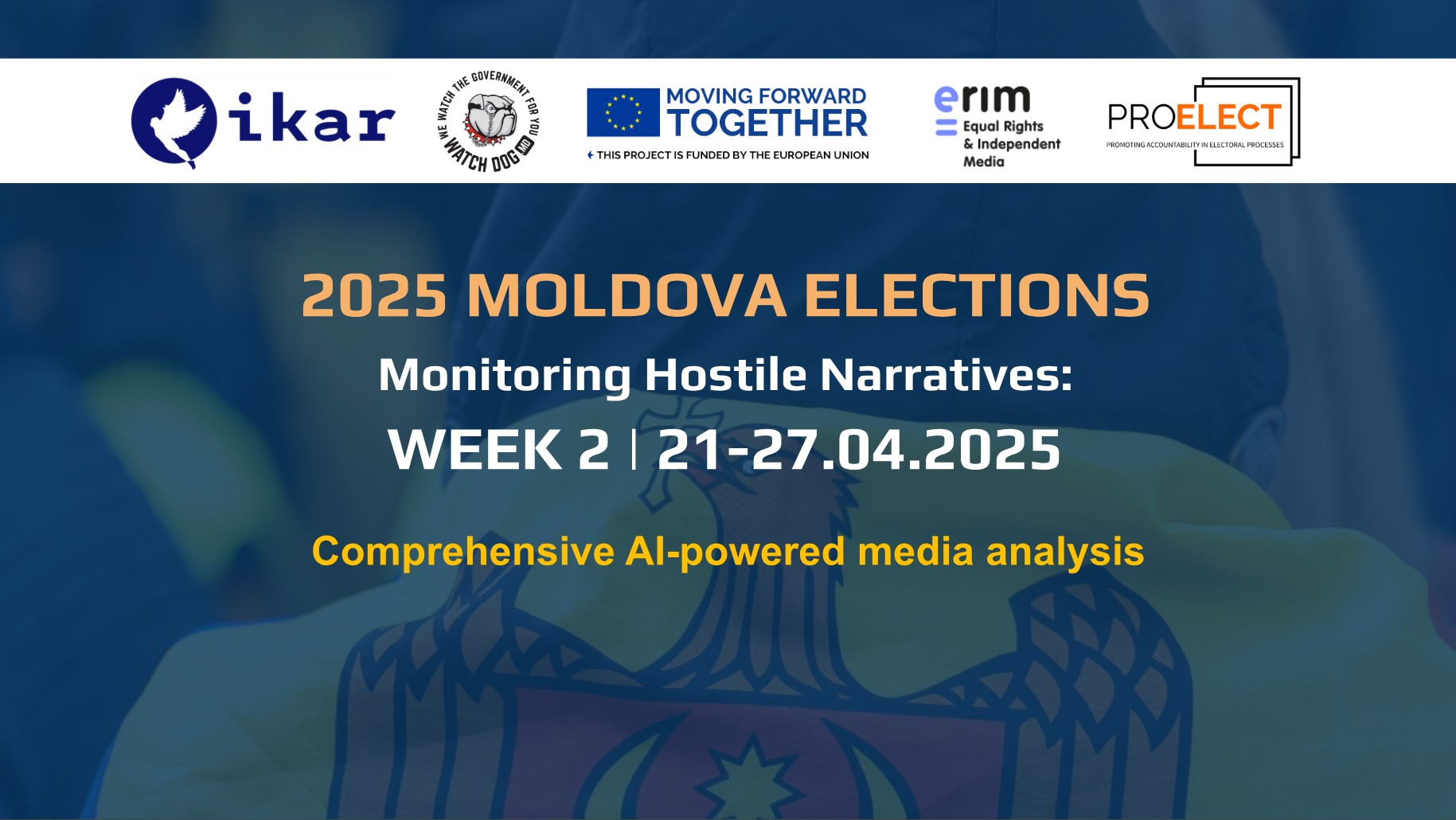
Monitoring Russian Narratives Regarding Moldova: 21-27.04.2025

The Institute for Conflict Studies and Analysis of Russia, together with Watchdog MD, continues weekly monitoring of Russian propaganda attempts to interfere in the electoral process in Moldova and its attempts to influence the domestic political situation in this country. This publication was produced with the financial support of the European Union and Equal Rights & Independent Media (ERIM). Its contents are the sole responsibility of IKAR-WatchDog.MD and do not necessarily reflect the views of the EU and ERIM.

The weekly monitoring report aims to study social media to identify key propaganda narratives, trending topics, active propagandists, and audience engagement statistics related to Moldova’s political landscape. The data is collected from the Russian segment of Telegram using AI-powered tools and manual sampling.

Rating of topics that were discussed on 21-27 April 2025 in the Russian information space regarding the Republic of Moldova, focusing on such narratives: Moldova is being used to train terrorists, the Moldovan Orthodox Church is being oppressed, Chișinău banned the celebration of Victory Day on May 9, as well as the promotion of alternative opposition politicians.

  1. Russian propaganda continues to promote the narrative that “Moldova is used to train terrorists.” One week after Russia launched a disinformation campaign about Moldovans being involved in terrorist attacks, a new falsehood was spread regarding the detention of an alleged “Moldovan spy” from Chișinău’s intelligence services. This narrative was further reinforced by a travel risk warning issued to Russian citizens about visiting the Republic of Moldova. This clearly indicates a coordinated disinformation campaign aimed at the Russian public to portray Moldova as a threat.
  2. The promotion of the false claim about the ban on celebrating Victory Day on May 9th is being used to divide society and discredit the authorities in Chișinău. This falsehood is repeated every year around May 9th and is part of the broader narrative about “erasing historical memory.”
  3. An analysis of the appearances of Moldovan politicians in Russian media shows a shift in attention, from the Governor of Gagauzia, Evghenia Guțul, to other figures such as Igor Dodon, Ilan Șor, or even Ion Ceban. Recently, the messages of Victoria Furtună have also been promoted; she is supported in the presidential elections by the Șor group. This suggests that Russia is betting on multiple political figures in the upcoming parliamentary elections and is working to increase their visibility.
Related publications

Architecture of Russian Unmanned Expansion
Analytics

Architecture of Russian Unmanned Expansion

This analytical assessment documents the systemic transformation of Russian Federation unmanned aerial incursions over NATO and EU sovereign airspace between 2022 and 2026. Empirical evidence demonstrates that these unmanned aerial vehicle (UAV) sorties can no longer be characterized as sporadic anomalies or unintentional navigational deviations. Instead, they represent an integrated, state-directed military intelligence doctrine that…

Architecture of Russian Unmanned Expansion
Political Control Ahead of Russia’s Elections Extends Beyond the Anti-War Agenda
Analytics

Political Control Ahead of Russia’s Elections Extends Beyond the Anti-War Agenda

Russia’s political system is approaching the elections amid accumulated social tension and frustration. The continuation of the war sustains a high level of uncertainty, the prospect of a new wave of mobilization remains a sensitive issue, and worsening economic expectations are increasingly affecting Russians’ everyday lives. Rising prices, expensive loans, pressure on the state budget,…

Political Control Ahead of Russia’s Elections Extends Beyond the Anti-War Agenda
International Observers as a Mechanism of Electoral Legitimation in Russia
Analytics

International Observers as a Mechanism of Electoral Legitimation in Russia

The use of foreign nationals presented by Russian officials and state media as “international observers” or “experts” has become a regular feature of efforts to legitimize Russian elections. Unlike professional monitoring missions, which follow established methodologies and assess the entire electoral cycle, these observers often make short visits, attend a limited number of polling stations,…

International Observers as a Mechanism of Electoral Legitimation in Russia
Russia Faces Domestic Resilience Challenges Ahead of Elections
Analytics

Russia Faces Domestic Resilience Challenges Ahead of Elections

Amid persistent military tensions, several sensitive issues in Russia are converging into a broader agenda affecting domestic resilience. Expectations of mobilization are sustaining high levels of public anxiety, while the fuel crisis is increasing socioeconomic pressure. Against this backdrop, the upcoming elections are becoming a key test of the Russian state’s ability to maintain social…

Russia Faces Domestic Resilience Challenges Ahead of Elections