Key Information Trends in Russian Telegram Propaganda, Early November.
The information landscape surrounding Russia’s war against Ukraine continues to reveal a widening gap between battlefield reality and the narratives promoted by the Kremlin. Two major developments in early November illustrate how Russian state institutions increasingly prioritize perception management over operational transparency or accountability. Following successful Ukrainian strikes on strategic infrastructure in Volgograd, Saratov, and Novorossiysk, federal media rapidly framed the incidents as acts of “terrorism,” while pro-war commentators avoided discussing repeated air-defense failures. Simultaneously, Moscow intensified pressure on its military to demonstrate progress near Pokrovsk and Kupyansk, leading to misleading claims of tactical success that were later contradicted by evidence of significant losses.
These events, combined with Russia’s reaction to the U.S. President’s announcement of a potential nuclear test, show a consistent pattern: official channels rely on dramatic rhetoric, emotional framing, and selective reporting to project an image of control. In contrast, data from military bloggers and informal sources indicates growing skepticism and uncertainty regarding Russia’s strategic direction. Together, these dynamics highlight a regime increasingly dependent on controlled messaging to obscure operational weaknesses, sustain public support, and delay acknowledgment of the structural problems shaping its military and political decision-making.
Kremlin Narrative Discipline Amid Repeated Ukrainian Strikes
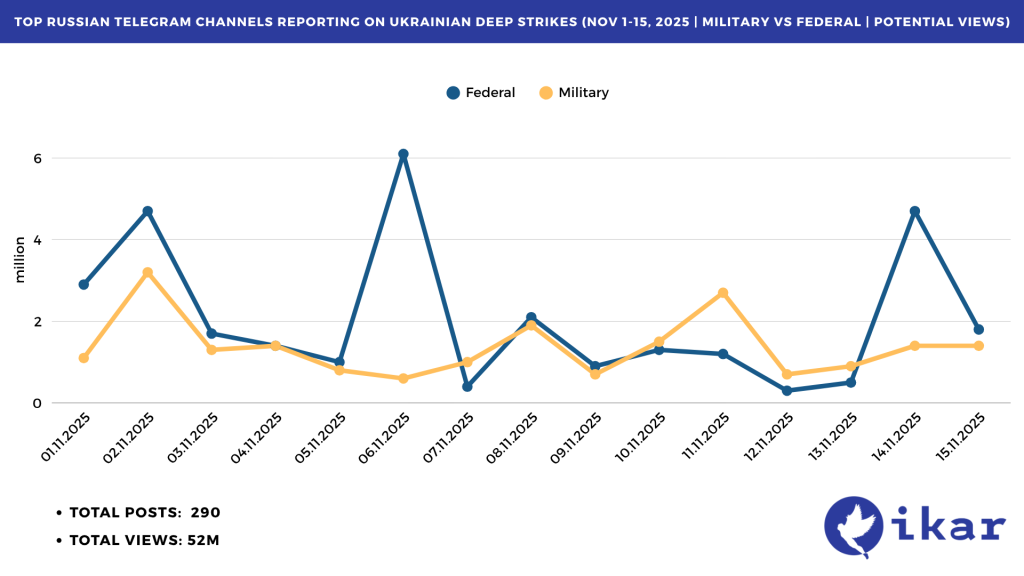
On November 6 and 14, the Ukrainian Army carried out successful drone and missile strikes against strategic sites in Volgograd, Saratov, and Novorossiysk, damaging key fuel and military-industrial infrastructure. The information response followed a consistent pattern: Russian federal media immediately amplified narratives framing the attacks as “terrorism.” At the same time, military bloggers avoided operational details and refrained from criticizing command failures.
Combined data* from both incidents shows a coordinated effort to manage perception rather than address vulnerabilities. Faced with repeated air-defense failures, the Kremlin relies on emotional propaganda and controlled messaging to mask systemic weaknesses, prioritizing narrative stability over acknowledging responsibility.
Kremlin Hides Losses Near Pokrovsk
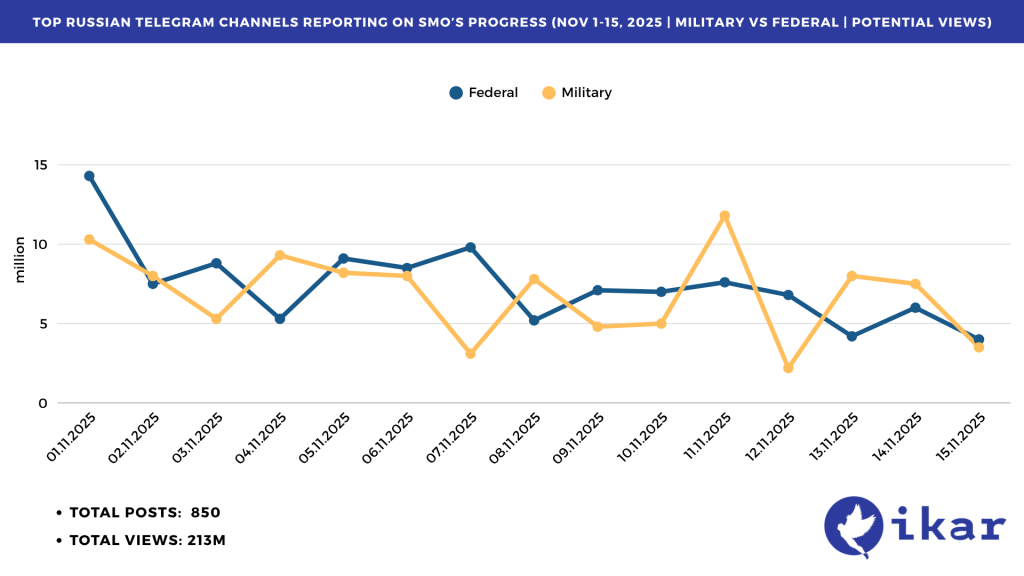
The Russian army, under a direct order to capture Pokrovsk and Kupyansk by mid-November, is attempting to demonstrate both capability and loyalty to the Kremlin. Pro-war channels aggressively circulated claims that Russian assault units had already entered Pokrovsk using light armored vehicles. However, subsequent information confirmed that this premature leak exposed the units’ movement, allowing Ukrainian forces to eliminate them.
Aware of its prolonged inability to seize Pokrovsk, the Kremlin has intensified disinformation efforts, promoting narratives about a “complete encirclement” of Ukrainian defenders and presenting exaggerated claims of operational success*. At the same time, Russian media systematically conceals the heavy losses incurred in this sector of the front, attempting to mask failure through inflated reports and controlled messaging.
Nuclear Posturing Used to Mask Strategic Uncertainty
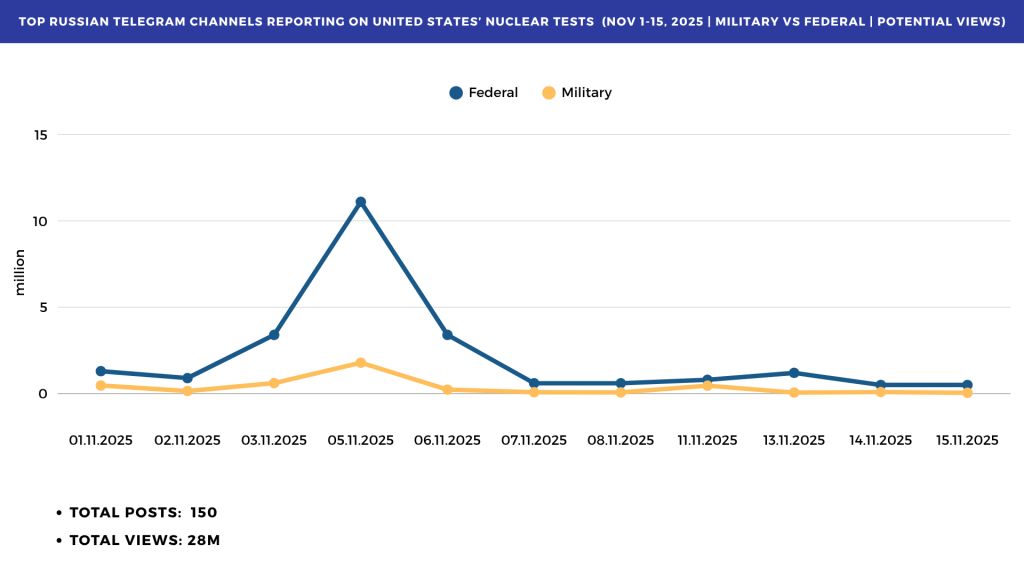
Another high-profile event in November was the U.S. President’s announcement of plans to conduct the first nuclear weapons test in many years. Immediately after the statement, Russian media flooded the information space with reactions from senior officials, including the president and defense minister, calling for “decisive response actions”. For Russian propaganda, this became an opportunity to reassure the domestic audience of Russia’s supposed unmatched nuclear potential and to reinforce the image of a strong, authoritarian regime maintaining full control.
However, as the data shows*, military bloggers reacted far more skeptically. Their restrained and often doubtful commentary suggests that behind the loud official rhetoric, the Russian military-political leadership lacks a coherent strategy for concluding its operation in Ukraine ‒ and relies on nuclear posturing as a substitute for real planning.