“VICTORY PLAN” BY V. ZELENSKY: REACTION OF THE KREMLIN AND THE RUSSIANS

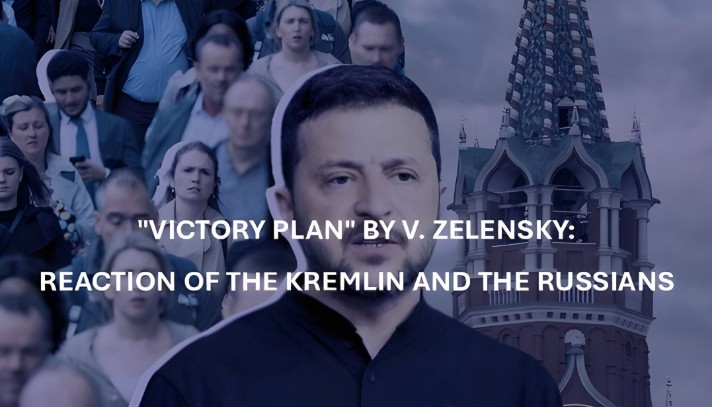
“VICTORY PLAN” BY V. ZELENSKY: REACTION OF THE KREMLIN AND THE RUSSIANS

In their statements representatives of the Kremlin, including Vladimir Putin himself, dismissed the possibility of peace negotiations based on Ukrainian proposals or any plans intended to end the war. Currently, the main such a plan is the “Victory Plan,” first mentioned by Volodymyr Zelenskyy in August 2024 and publicly presented by President in the parliament on October 16, 2024.

Following the public presentation of the “Victory Plan” by the President of Ukraine, the Institute for Conflict Studies and Analysis of Russia conducted a study of its perception in the Russian media space.

Analysis of messages from Russian TV channels and video platforms using a specialized AI-powered tool War of Words, as well as the use of the AI platform Osavul to study social networks, allows us to demonstrate the real level of interest in the topic of Vladimir Zelensky’s “Victory Plan” – both of Russian state propaganda and ordinary Russians.

The results of the study indicate that Russians expressed strong interest in Volodymyr Zelenskyy’s initiative after its first mention in late August 2024, with over 7 million people viewing the relevant messages then.

The total publication views regarding the “Victory Plan” during the mentioned period reached 181 million. The number of publications regarding the “Victory Plan” for the mentioned period exceeds 20 thousand. Russian users’ reactions to relevant publications reached 3.5 million.

The analysis also shows the active involvement of Kremlin-affiliated sources in covering the “Victory Plan,” spreading false and distorted information about the strategy presented by President Zelenskyy. The analysis identified 852 compromised sources out of a total of 7,130.
Related publications

Political Control Ahead of Russia’s Elections Extends Beyond the Anti-War Agenda
Analytics

Political Control Ahead of Russia’s Elections Extends Beyond the Anti-War Agenda

Russia’s political system is approaching the elections amid accumulated social tension and frustration. The continuation of the war sustains a high level of uncertainty, the prospect of a new wave of mobilization remains a sensitive issue, and worsening economic expectations are increasingly affecting Russians’ everyday lives. Rising prices, expensive loans, pressure on the state budget,…

Political Control Ahead of Russia’s Elections Extends Beyond the Anti-War Agenda
International Observers as a Mechanism of Electoral Legitimation in Russia
Analytics

International Observers as a Mechanism of Electoral Legitimation in Russia

The use of foreign nationals presented by Russian officials and state media as “international observers” or “experts” has become a regular feature of efforts to legitimize Russian elections. Unlike professional monitoring missions, which follow established methodologies and assess the entire electoral cycle, these observers often make short visits, attend a limited number of polling stations,…

International Observers as a Mechanism of Electoral Legitimation in Russia
Russia Faces Domestic Resilience Challenges Ahead of Elections
Analytics

Russia Faces Domestic Resilience Challenges Ahead of Elections

Amid persistent military tensions, several sensitive issues in Russia are converging into a broader agenda affecting domestic resilience. Expectations of mobilization are sustaining high levels of public anxiety, while the fuel crisis is increasing socioeconomic pressure. Against this backdrop, the upcoming elections are becoming a key test of the Russian state’s ability to maintain social…

Russia Faces Domestic Resilience Challenges Ahead of Elections
Building a Nation Under Arms: Russia From Mobilization to Military Socialisation
Analytics

Building a Nation Under Arms: Russia From Mobilization to Military Socialisation

Russia’s substantial wartime losses and declining effectiveness of contract-based recruitment raise growing questions about its ability to sustain the front’s manpower needs without renewed mass mobilization. IKAR’s study examines Russia’s available and emerging mechanisms for replenishing military personnel, public attitudes toward mass mobilization and its potential political consequences, and the feasibility of various mobilization scenarios.…

Building a Nation Under Arms: Russia From Mobilization to Military Socialisation