
This analytical assessment documents the systemic transformation of Russian Federation unmanned aerial incursions over NATO and EU sovereign airspace between 2022 and 2026. Empirical evidence demonstrates that these unmanned aerial vehicle (UAV) sorties can no longer be characterized as sporadic anomalies or unintentional navigational deviations. Instead, they represent an integrated, state-directed military intelligence doctrine that combines methodical reconnaissance-in-force, the systemic exploitation of sanctions compliance loopholes, the operationalization of commercial maritime shadow fleets as forward staging platforms, and the mobilization of decentralized proxy cells. Crucially, this posture has shifted to direct industrial and logistical sabotage below the threshold of open warfare, under the deliberate cover of attributional ambiguity.
CONCEPTUAL FRAMING: FROM HUMINT DEGRADATION TO AN INTEGRATED UNMANNED COERCION ARCHITECTURE
The Kremlin’s full-scale invasion of Ukraine in February 2022 and the subsequent expulsion of over 400 Russian intelligence officers operating under diplomatic cover across the European Union dealt an unprecedented blow to Moscow’s traditional human intelligence (HUMINT) posture throughout Europe. Concurrently, Russia’s persistent structural inability to field responsive, high-resolution synthetic-aperture radar (SAR) and electro-optical (EO) spaceborne reconnaissance constellations generated an operational intelligence deficit for the General Staff of the Russian Armed Forces.
To mitigate this strategic vulnerability, the Main Directorate of the General Staff of the Armed Forces of the Russian Federation (GRU, specifically specialized elements within Military Unit 29155 and Military Unit 55111), in institutional coordination with Directorate “P” (Industrial Counterintelligence) of the FSB Economic Security Service, deployed a multi-layered, cross-domain unmanned aerial system (UAS) architecture designed to operate continuously across the gray zone.
This unmanned offensive is structurally integrated with Moscow’s illicit sanctions-evasion logistics. By weaponizing commercial shipping routes, flag-of-convenience corporate structures, domestic gaps in Western labor and immigration laws, and unresolved jurisdictions within the international law of the sea, Russian intelligence services have integrated commercial maritime and inland logistics into an operationalized reconnaissance-sabotage complex.
The campaign’s operational objective aligns directly with Russia’s doctrine of Strategic Operations for the Defeat of Critically Important Objects (SODTsO). Incursions serve a dual-track strategic imperative: passively mapping NATO critical national infrastructure (CNI) and nuclear deterrence nodes to curate comprehensive target catalogues, while actively illuminating Allied integrated air and missile defense (IAMD) architectures. These intrusive sorties force the activation of Allied radars, capturing the operational emitter frequencies of Patriot, NASAMS, and IRIS-T batteries while benchmarking the Quick Reaction Alert (QRA) intercept timelines and political decision loops of Western defense commands.
OPERATIONAL VECTORS: MARITIME STAGING BASES AND TERRESTRIAL PROXY NETWORKS
The Maritime Vector: Sanctions-Evading Shadow Fleets as Autonomous Offshore Staging Platforms
A primary axis of Russia’s unmanned surveillance footprint relies on converting non-compliant crude tankers, dry bulk carriers, and auxiliary survey vessels operating under flags of convenience into mobile, autonomous forward-launch platforms for medium- and long-range fixed-wing UAVs with wingspans ranging from 3 to 6 meters.

The Russian Maritime Register of Shipping (RMRS) serves as the sovereign administrative facilitator of this enterprise, extending statutory certification and legal classification cover to commercial tonnage engaged in clandestine intelligence collection.
Operating within Exclusive Economic Zones (EEZ) and vital maritime chokepoints across the North and Baltic Seas, these converted commercial vessels launch Orlan-10 platforms, converted civilian airframes, and loitering munitions directly from open cargo decks.
This operational profile secures sustained maritime endurance and deniability while eliminating land-based radar departure signatures, enabling platforms to approach coastal radar perimeters at low altitudes before shore-based sensors acquire them.
The Terrestrial Vector: Disposable Proxies, Telegram Recruitment, and Cross-Border 5G Teleoperation
Complementing seaborne staging vectors, the Kremlin has established distributed ground sabotage nodes embedded directly within Western domestic territory. Exploiting the porous distribution of commercial off-the-shelf (COTS) electronic components and localized informal labor markets, the GRU has phased out the physical footprint of career intelligence officers during tactical launch phases, relying instead on recruited disposable proxies (disposable proxies).
In operational theatres such as the United Kingdom, during the November 2024 reconnaissance flights targeting United States Air Force installations in East Anglia (RAF Feltwell, Mildenhall, and Lakenheath), operatives executed tactical launches from agricultural land while masquerading as seasonal agricultural workers, effectively obstructing rapid attribution and combatant identification. Across North America, procurement networks have acquired heavy civilian airframes through commercial retail outlets, then flashed systems with custom software modifications to defeat mandatory geofenced no-fly boundaries. The integration of recruited foreign nationals—as demonstrated in the prosecution of Fengyun Shi—adds another layer of operational insulation, enabling Moscow to mask state-sponsored strategic collection beneath the veneer of localized industrial espionage.
The technical culmination of this distributed ground network materialized during the August 2026 sabotage operation targeting Leipzig/Halle Airport. A weaponized strike FPV platform was staged from the abandoned village of Kursdorf/Kabelsketal, utilizing an array of high-throughput industrial 5G routers and RF repeaters. This topology allowed tactical flight operations to be conducted remotely from third-party countries or directly from Russian territory, establishing comprehensive attributional ambiguity and decoupling the flight operator from the physical point of departure.
STRATEGIC TEMPO, GEOGRAPHIC PATTERNS, AND RECONNAISSANCE-STRIKE TREND ANALYSIS
Between 2022 and 2026, Russian unmanned aerial operations over the West evolved through four distinct operational phases, defined by escalating technical sophistication, shifting operational targets, and a deliberate compression of response times:
Phase 1: Foundational Stress-Testing and Attributional Probing (2022–2023)
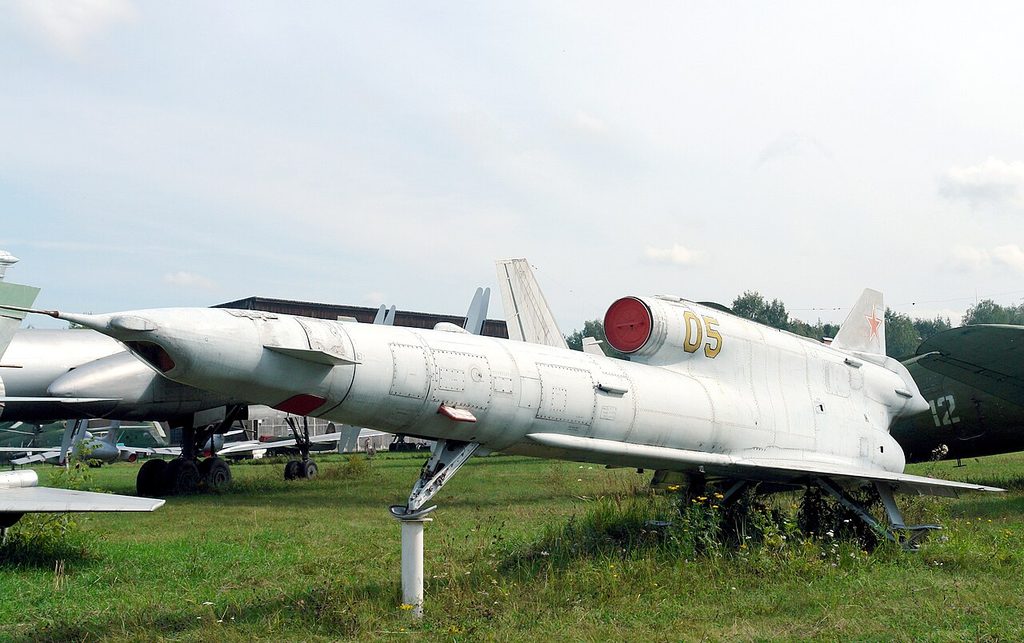
The initial phase opened with high-kinetic, single-vector penetrations designed to exploit fault lines between national command centers and NATO integrated structures. The transit of a 6-ton Soviet-heritage Tu-141 Strizh carrying an OFAB-100-120 bomb through Romania and Hungary before crashing in Zagreb, Croatia, on March 10, 2022, exposed critical procedural delays in Allied peer-to-peer notification chains.
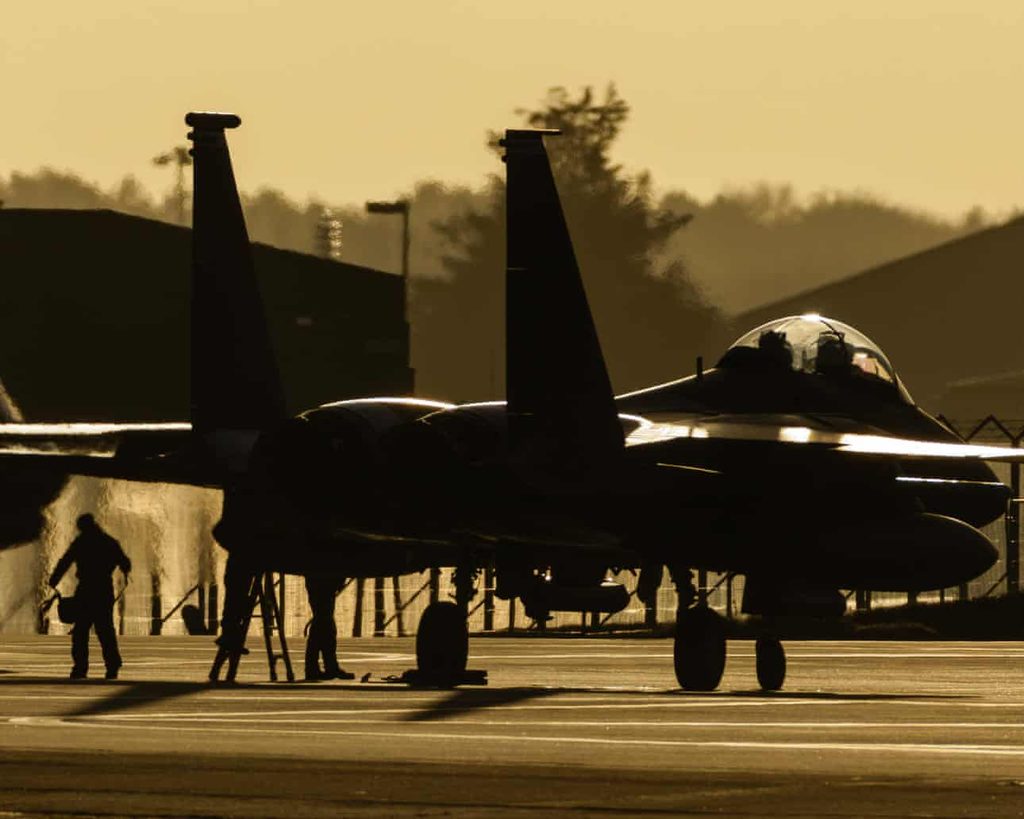
By late 2023, the operational aperture widened across the Atlantic: probing operations penetrated the Prohibited Airspace (P-48) of the Nevada National Security Site, while prolonged multi-UAV incursions over Joint Base Langley-Eustis across 17 consecutive nights demonstrated the vulnerabilities of domestic military base perimeters, forcing the operational dispersal of advanced F-22A Raptor fighter squadrons.
Phase 2: Maritime Shadow Fleet Integration and CNI Mapping (2024–Mid 2025)
During 2024 and early 2025, Russian intelligence moved from opportunistic incursions to disciplined offshore mapping of strategic logistics and energy assets. Persistent surveillance over the ChemCoast industrial park, LNG terminals, and the decommissioned Brunsbüttel nuclear plant in August 2024 showed an operational focus on critical civilian energy hubs. This was expanded in November 2024 into coordinated offshore-onshore operations targeting RAF bases Lakenheath, Mildenhall, and Feltwell, timed specifically to coincide with infrastructure upgrades designed to receive modernized B61-12 thermonuclear ordnance. The maritime axis became explicit through naval stalking incidents, including the three-hour pursuit of the German Federal Police cutter Potsdam in the North Sea and dedicated surveillance sorties directed against naval shipyards and submarine assets in Eckernförde and Kiel.
Phase 3: Infrastructure Paralysis and Strategic Nuclear Probing (Late 2025–Early 2026)
By late 2025, incursions were leveraged to trigger acute economic and civic disruption while aggressively challenging primary strategic assets. The coordinated deployment of heavy UAS formations displaying active strobe lights over Copenhagen, Aalborg, and Billund airports in September 2025 completely paralyzed civil aviation across Denmark for four hours, grounding 190 flights while probing the Skrydstrup airbase hosting Ukrainian F-16 training personnel. Simultaneously, offshore platforms escalated surveillance flights over Western Europe’s most sensitive defense sites, mounting multiple incursions against the B61-12 nuclear vaults at Volkel Air Base in the Netherlands, penetrating the sovereign airspace of the French Strategic Oceanic Force (FOST) ballistic missile submarine base at Île Longue, and maneuvering close to the French aircraft carrier Charles de Gaulle off Malmö until neutralized by Swedish electronic attack.
Phase 4: Industrial Sabotage, Civil Casualties, and Collective Defense Activation (2026)
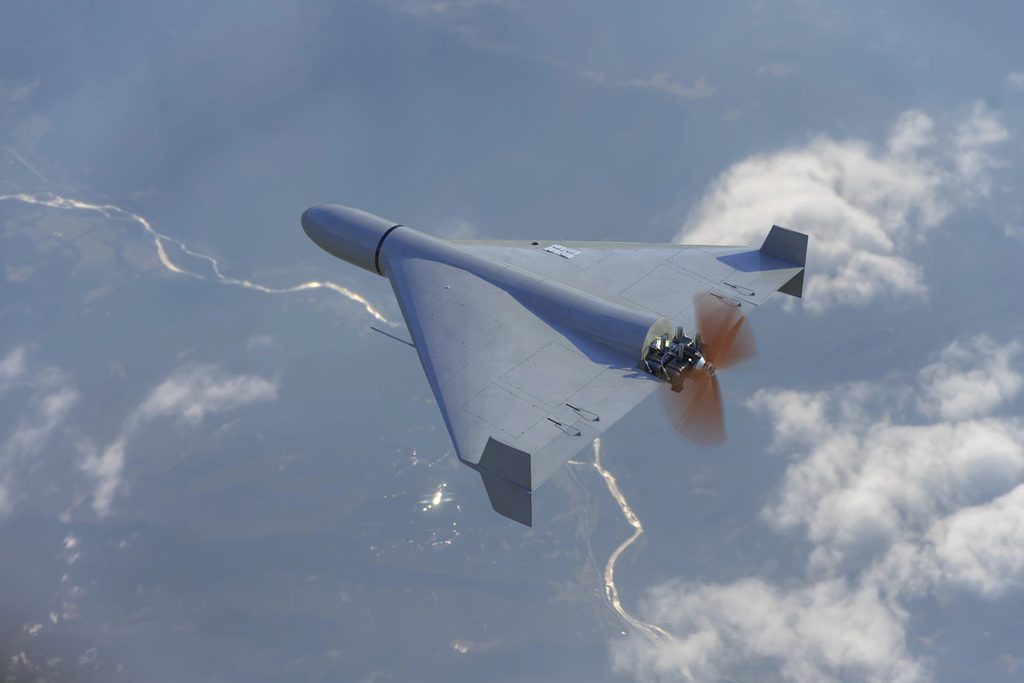
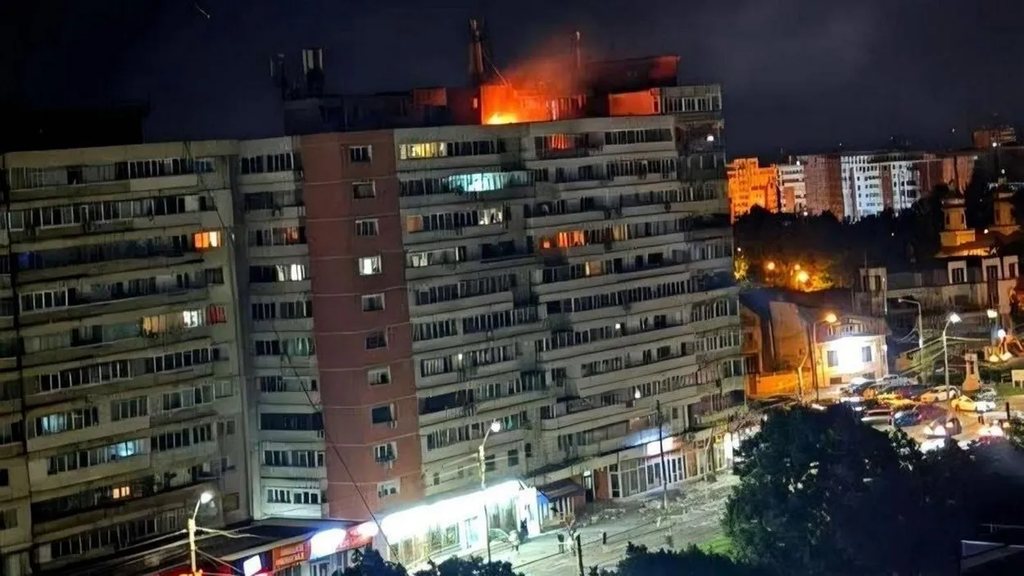
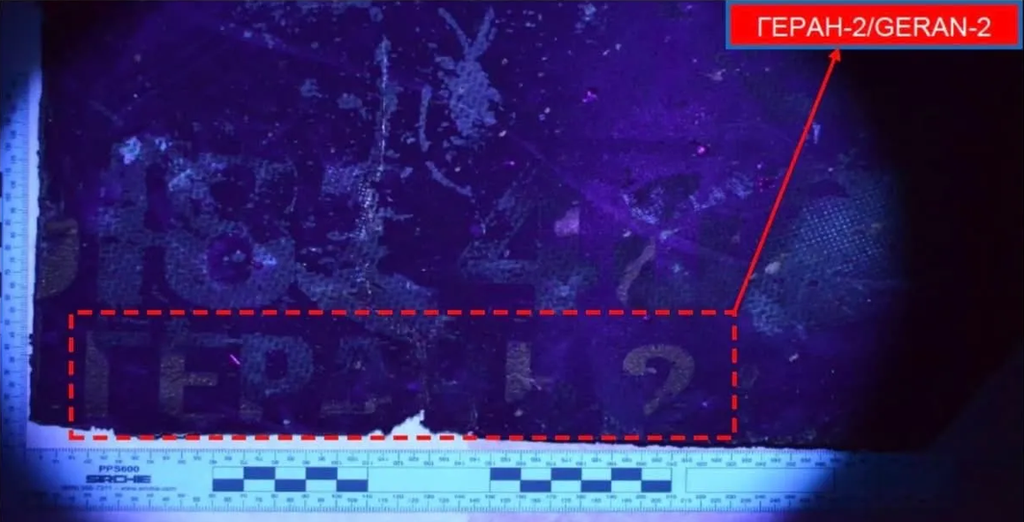
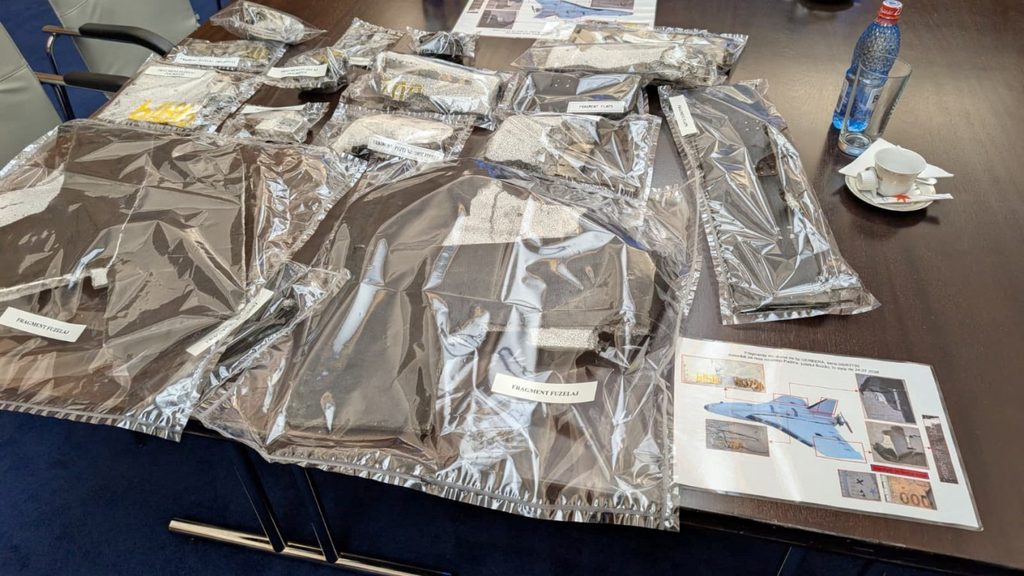
The strategic threshold was breached in spring and summer 2026 as Moscow pivoted directly to destructive kinetic operations. On May 29, 2026, a Russian Geran-2 strike platform impacted a residential apartment complex in Galați, Romania, causing significant fires and wounding two civilians—marking the first direct civilian casualties sustained by a NATO member state from a Russian unmanned strike.
In August 2026, this doctrine moved into direct industrial sabotage when an FPV platform carrying high-grade Semtex attempted to destroy an Antonov Airlines An-124-100 strategic airlifter operating under NATO’s SALIS contract at Leipzig/Halle Airport, triggering an airborne collision with a commercial DHL cargo airliner. The campaign culminated on September 9, 2026, with a massed, 21-vehicle penetration of Polish sovereign airspace that forced the closure of major air hubs and drove the Polish government to formally trigger consultations under Article 4 of the Washington Treaty.
TACTICAL AND STRATEGIC FORECAST: FUTURE STRIKE TECHNOLOGIES AND THREAT EVOLUTION
The trajectory of Russian unmanned operations over Western sovereign territory indicates a definitive shift toward continuous, industrial-scale logistics sabotage. Four primary technological vectors define this evolution:
Autonomous Edge-AI Terminal Guidance (Pixel Lock / Optical Scene Matching)
Deploying low-power neuromorphic edge-computing processors eliminates dependence on vulnerable satellite navigation links, rendering conventional GNSS spoofing and jamming ineffective. Operating under Digital Scene Matching Area Correlation (DSMAC) logic, incoming platforms match real-time onboard optical feeds against pre-loaded orthophotomaps and synthetic CAD profiles of critical Western infrastructure—including aircraft flight decks, 380 kV transformers, and LNG containment domes—executing terminal engagement in total radio silence (EMCON).

Tethered Micro-Spool Fiber-Optic Control Links
Forward-deployed sabotage cells are adopting micro-spool fiber-optic lines that provide 10 to 20 kilometers of physical operational reach for FPV strike systems. Because guidance commands and video return feeds travel along glass fibers, the platform emits zero radio-frequency signature, is immune to all deployed RF electronic warfare assets, and provides operators with pristine, latency-free control.
Asymmetric Attrition Warfare (Cost-Imposition)
The systematic release of low-cost expanded polystyrene (EPS) and plywood decoys costing under $3,000 forces Allied air defense elements to scramble frontline fighter assets at exorbitant flight-hour costs while expending high-end interceptor missiles, rapidly exhausting Allied interceptor stocks.
False-Flag Kinetic Sabotage
Moscow is increasingly fielding hybrid, uncrewed systems that visually and structurally mimic Ukrainian long-range strike architectures. These operations are engineered to inflict deliberate collateral damage on civilian or critical infrastructure within NATO states, specifically to generate political fractures within the Western alliance and undermine public support for defense assistance.

STRATEGIC COUNTERACTION PLAN: ACTIONABLE DIRECTIVES FOR WESTERN DEFENSE PARTNERS
Legal, Regulatory, and Counterintelligence Directives
Revision of Peacetime Rules of Engagement (ROE)
Allied governments must dismantle peacetime statutory frameworks that mandate cumbersome civilian aviation deconfliction or prior visual intercept verification over designated defense sites. Garrison commanders protecting critical installations—including nuclear storage depots, operational air bases, and naval arsenals—must have clear statutory authority to employ immediate kinetic and directed-energy fires against any unauthorized unmanned system that penetrates restricted base airspace.
Maritime Interdiction Operations Under UNCLOS (Articles 92 & 110)
NATO and the European Union must establish a dedicated maritime interdiction task force across the Baltic and North Seas. Operating under Articles 92 and 110 of the UN Convention on the Law of the Sea, Allied naval assets must systematically execute visit, board, search, and seizure (VBSS) operations against sanctioned shadow fleet vessels that manipulate their AIS transponders, display fraudulent flag documentation, or carry undeclared tactical unmanned systems and technical personnel.
Dismantling Administrative and Commercial Enablers
Western authorities must revoke operating permits and shutter all European offices of the Russian Maritime Register of Shipping (RMRS). Concurrently, private military contractors serving as operational umbrellas for Russian special services—such as the Moran Security Group—must be formally designated as transnational terrorist entities, subjecting their corporate leadership, maritime crews, and FSB handlers to asset seizures and criminal prosecution.
Integrated cUAS Architectural and Engineering Directives
Multi-Sensor Fusion Surveillance Networks
Strategic logistics hubs, training bases, and nuclear installations must be protected by integrated sensor grids that fuse 3D millimeter-wave radars, passive RF packet sniffers, distributed acoustic arrays calibrated to drone motor frequencies, and optical/MWIR tracking suites to track non-emitting targets.
Directed-Energy and Low-Collateral Kinetic Interceptors
Allied commands must prioritize the rapid field deployment of high-power microwave (HPM) systems capable of disabling the internal electronics of drone swarms simultaneously without creating hazardous ballistic fallout. Perimeter defenses must be reinforced with reusable, high-speed interceptor drones equipped with net-capture or direct-impact mechanisms.
Hardened Structural Protection (HOP Framework)
Facilities must deploy passive physical defenses across key logistical nodes, including high-tensile steel overheads and Kevlar netting over open aircraft aprons, high-voltage transformers, and fuel distribution points to blunt the shaped-charge impact of tactical FPV munitions.