Executive Summary
On the day of Armenia’s parliamentary elections, debate focused on two core issues: the legitimacy of the government and the country’s sovereignty in shaping its future. Prime Minister Nikol Pashinyan and his government emphasized anti-corruption measures, efforts to prevent vote-buying, and tighter oversight of the electoral process. They also framed the election as a test of Armenia’s ability to maintain an independent foreign policy and make sovereign strategic choices.
This discussion took place amid increased external pressure. Statements by Russian officials, warnings about the economic risks of closer ties with the European Union, and repeated calls to choose between the EU and the Eurasian Economic Union became a visible part of the information environment. For parts of the public, these messages were seen not just as political commentary, but as attempts to influence Armenia’s direction, reinforcing sovereignty as a central issue in the election.
The opposition focused mainly on criticism of the government’s performance, especially in socio-economic policy and state management, drawing on public dissatisfaction and nostalgia for earlier stability. Still, it offered limited articulation of a structured alternative policy agenda. As a result, the debate was dominated more by criticism of the current leadership and external pressure narratives than by clearly defined competing development models for the country.
“…the more authorities try to silence dissenting voices, the louder the question becomes: is this really where Nikol Pashinyan is leading Armenia?”
Following the conclusion of voting, the information campaign entered a new phase. The focus gradually shifted away from influencing voter choice and toward shaping perceptions of the election outcome. Within the Russian information space, procedural aspects of vote counting, discrepancies between exit polls, and statements by opposition figures began to be framed as evidence of possible irregularities. Rather than discussing the political implications of the results, media coverage increasingly concentrated on questioning the credibility of the electoral process itself.
Beyond claims of election violations and pressure on the opposition during voting day, Russian propaganda focused on promoting the narrative that Pashinyan’s Civil Contract party failed to surpass the 50% threshold and secure a parliamentary majority. This was used to reinforce an existing narrative that Armenian society remains divided and that significant shifts in the country’s foreign policy course are neither broadly supported nor advisable.
This shift was particularly visible in a June 8 article published by Komsomolskaya Pravda, presenting elections through a broader narrative of alleged manipulation and electoral fraud. References to conflicting exit-poll data, technical issues during the counting process, and opposition claims created uncertainty around the official results. The article also introduced comparisons with Moldova, placing the Armenian vote within a wider Russian narrative that portrays elections in pro-European countries as vulnerable to manipulation and external influence:
“A Moldovan scenario, Moldovan numbers exactly the same.”
As a result, the discussion moved beyond the election outcome toward questions of legitimacy. The emerging narrative suggested that the government’s victory was secured not through voter support but through administrative intervention in the counting process. In doing so, it laid the groundwork for continued challenges to the credibility of the election and reinforced broader claims about alleged democratic deficiencies in countries pursuing closer ties with the West.
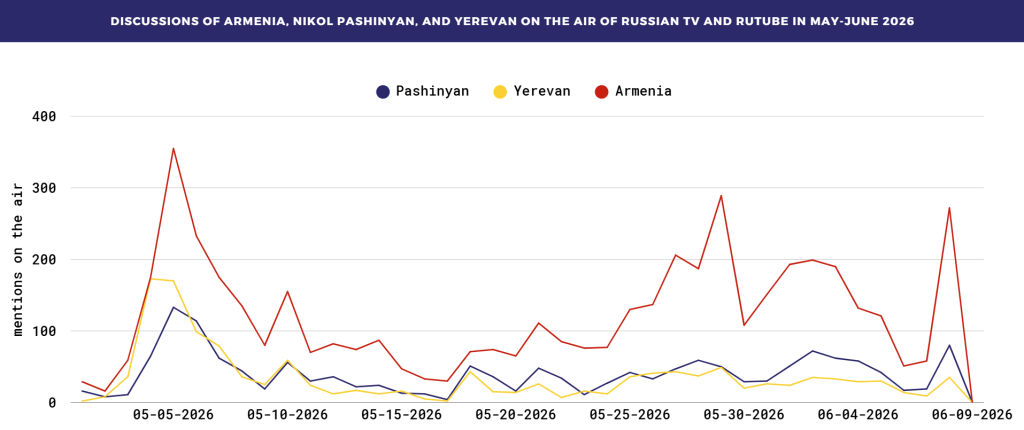
Campaign Evolution: From Foreign Policy Choice to an Internal Political Dilemma
During the early stages of the campaign, Russian messaging on Armenia largely followed a familiar pattern, focusing on criticism of closer ties with the European Union and warnings about the risks of moving away from Russia. However, as the election approached, this narrative evolved into a more rigid and confrontational framework.
Rather than debating the costs and benefits of different foreign policy options, Russian political and media actors increasingly promoted the idea that Armenia faced a fundamental choice between two incompatible paths. The possibility of maintaining balanced relations with both Russia and the European Union was gradually dismissed as unrealistic. This message was reflected in statements such as:
“We have always been with Russia and always will be.”
Within this narrative, efforts to pursue a multi-vector foreign policy were portrayed as either misguided or disloyal. The discussion shifted from policy preferences to questions of geopolitical alignment, framing Armenia’s future as a choice between competing centers of power rather than between alternative political programs.
As a result, the election campaign became increasingly linked to broader questions of identity and strategic orientation. Voters were encouraged to view the country’s future not through the lens of domestic policy priorities, but through a broader geopolitical framework in which Armenia was expected to choose between continued alignment with Russia and deeper integration with Western institutions. This binary framing reduced the space for more specific positions and transformed a political debate into a broader discussion about the country’s place in the regional and international order.
Economic Dependence as a Tool of Political Influence
Alongside security concerns, economic arguments became one of the central pillars of the Russian information campaign. A significant share of the messaging was built around the idea that Armenia’s economy remained deeply dependent on Russia and that any attempt to move away from this relationship would come at a substantial cost.
Russian officials, state media, and affiliated commentators repeatedly argued that Armenia could not maintain economic stability without access to the Russian market, Russian energy resources, and the broader framework of Eurasian economic integration. These claims were often accompanied by dismissive assessments of Armenia’s prospects in Europe:
“Nobody in Europe needs Armenian vegetables, fruit, water, or cognac, even for free.”
The purpose of these messages was less about providing an economic analysis and more about shaping public perceptions. The underlying narrative suggested that Armenia’s current economic model had no realistic alternative and that any effort to diversify trade, investment, or political partnerships would inevitably lead to economic hardship.
This message was frequently condensed into a simple and emotionally resonant claim:
“Without Russia, Armenia will not be able to sustain itself.”
Such arguments reflect a broader and long-standing Russian narrative toward post-Soviet states, one that portrays economic dependence on Russia as both natural and unavoidable. Within this framework, integration with Russia is presented as a source of stability and prosperity, while efforts to expand economic ties with other partners are depicted as risky experiments with potentially severe consequences.
The narrative gained additional visibility through statements by senior Russian officials, including Vladimir Putin, Alexey Overchuk, and Dmitry Peskov. Their comments repeatedly emphasized the perceived incompatibility of deeper integration with the European Union and continued participation in the Eurasian Economic Union. They also raised the prospect of higher energy prices, reduced access to the Russian market, and changes to the status of Armenian labor migrants in Russia, reinforcing the message that geopolitical choices could carry immediate economic consequences.
The Ukrainian Case as a Universal Threat
As election day drew closer, comparisons with Ukraine became one of the most prominent themes in the Russian information campaign. What began as criticism of Armenia’s foreign policy choices gradually evolved into a broader narrative portraying Ukraine as a warning about the consequences of moving closer to the West.
A recurring message across media coverage and political commentary was that Armenia was following the same path that Ukraine had taken in the years before the war:
“Overall, the situation in Armenia today is similar to what Ukraine once experienced.”
This comparison went far beyond foreign policy. It brought with it a wider set of associations, including war, economic decline, social instability, demographic losses, and the erosion of national sovereignty. By linking Armenia’s political trajectory to Ukraine’s experience, the campaign framed the election not simply as a democratic choice between competing political forces, but as a decision that could determine the country’s future security and stability.
Within this narrative, voters were presented with a stark choice. On one side stood the prospect of repeating what was described as the “Ukrainian scenario”; on the other, continued stability through close relations with Russia. The message sought to transform a political debate into a question of national survival.
The narrative was further reinforced by claims that responsibility for Ukraine’s destruction lay entirely with the West:
“The West simply destroyed Ukraine.”
By presenting events through this lens, pro-Russian commentators and political figures argued that closer integration with Western institutions could expose Armenia to similar risks, including economic disruption, loss of sovereignty, and security challenges. The Ukrainian case thus served as a powerful emotional reference point, used to discourage support for a pro-European course and to frame geopolitical realignment as inherently dangerous.
A similar communication strategy was observed during Georgia’s 2025 election campaign, when images and videos contrasting war-damaged Ukrainian cities with peaceful Georgian urban centers were widely circulated in media and public advertising. In both cases, Ukraine was used not as a subject of discussion in its own right, but as a symbolic warning intended to shape voter perceptions and influence political choices.
Personalization of Political Risk
As the campaign progressed, criticism of Armenia’s political course became increasingly focused on Prime Minister Nikol Pashinyan personally. Rather than concentrating on institutions, policies, or broader political developments, many narratives framed him as the central figure responsible for nearly every challenge facing the country.
A recurring theme was the portrayal of Pashinyan as the main vehicle through which external actors, particularly the European Union, were allegedly influencing Armenia’s internal affairs:
“Through Pashinyan, the European Union is attempting to push the Russian Orthodox Church out of Armenia.”
Within this framework, complex political, economic, and geopolitical developments were reduced to the decisions and intentions of a single leader. Pashinyan was depicted not merely as a policymaker pursuing a particular course, but as an individual deliberately steering Armenia toward the same outcome that Russian commentators associated with Ukraine. This personalization simplified the political narrative, making it easier to frame national challenges through the actions of one person rather than through broader structural factors.
The campaign also incorporated a range of discrediting claims aimed at undermining Pashinyan’s personal legitimacy. These included historical and biographical allegations that were only loosely connected, if at all, to contemporary political issues:
“His grandfather, Nikol Vartanovich Pashinyan, fought on the side of Nazi Germany.”
Such claims served less as evidence-based political criticism and more as attempts at moral delegitimization. By invoking emotionally charged historical associations, they sought to damage Pashinyan’s public image and weaken trust in his leadership.
As a result, responsibility for a wide range of political, economic, and security risks became increasingly concentrated around Pashinyan himself. The broader debate over Armenia’s future direction was gradually reframed as a judgment on a single political figure, allowing criticism of government policy to be translated into a more personalized and emotionally resonant campaign against the prime minister.
Authoritarian Stability as a Contrasting Model
Alongside criticism of Armenia’s political system, an implicit contrast was drawn between Armenia’s democratic model and Russia’s centralized system of governance. In this framing, strong centralized authority was associated with stability and effectiveness, while political pluralism was linked to weakness and disorder.
This view was reflected in statements praising Vladimir Putin’s leadership:
“He has backbone. He holds his country together. Well, he holds it in his fist.”
Such messaging presented Putin as an example of strong and decisive leadership, emphasizing control and stability as key political virtues. In contrast, Pashinyan and Armenia’s more pluralistic political environment were indirectly portrayed as less stable and more vulnerable to internal division.
Overall, the narrative promoted the idea that centralized authority is a more effective governance model than democratic competition and institutional pluralism.
The Civilizational Dimension and Religious Framing
In the final stage of the campaign, a stronger civilizational framing became more visible. Political competition was increasingly described not as a debate over policy choices, but as a conflict of values. Within this framing, the European Union was portrayed less as a political partner and more as a force seen as threatening Armenia’s cultural and spiritual identity.
Armenia’s strategic choice was presented as a broader confrontation between a “traditional world” and a “liberal West,” which intensified the polarization around the election:
“Brussels’ ultimate goal is to sever the centuries-old ties between Armenia and Russia.”
In this narrative, different domestic issues: elections, opposition arrests, church-state relations, and economic policy – were grouped into a single external storyline. They were interpreted as parts of a coordinated Western effort to pull Armenia away from Russia.
As a result, domestic political processes were often stripped of independent internal dynamics, and government decisions were primarily explained through external influence from Brussels and the wider West. This framing functioned as an overarching structure linking otherwise separate themes in the campaign.
After the Elections: The Shift Toward Delegitimization
After the vote, the focus of the campaign changed quickly. Instead of trying to influence voters, the emphasis shifted toward questioning the results and building doubt around their legitimacy.
Russian media increasingly highlighted differences between exit polls and vote-counting data, as well as procedural details of the counting process, framing them as possible signs of irregularities. Technical and administrative aspects of election management were often reinterpreted as evidence of potential fraud.
On 8 June, Komsomolskaya Pravda published a piece that reflected this approach, presenting the election results through a narrative of alleged manipulation. It emphasized conflicting exit polls, reported technical disruptions, and selected political statements as indirect indicators of problems in the counting process:
“Such discrepancies immediately made the election outcome controversial and increased attention to the subsequent vote count.”
This framing created uncertainty about the results even before counting was fully completed, treating inconsistencies as grounds for questioning legitimacy.
At the same time, statements attributed to opposition figures were used to support claims of interference:
“When they saw that their numbers were shamefully and continuously declining, they simply stopped the count.”
This suggested that the election authorities deliberately halted the counting process after unfavorable results, reframing a procedural decision as political manipulation.
Another recurring element was comparison with Moldova:
“A Moldovan scenario, Moldovan numbers exactly the same.”
Such comparisons placed the Armenian elections within a broader narrative that portrays electoral processes in countries moving closer to the West as prone to fraud and external influence.
Taken together, these narratives encouraged the perception that the ruling party’s victory may have been driven not by voter support, but by manipulation of the counting process. The overall effect was to weaken trust in the official results and open space for contesting their legitimacy.
In this way, the elections were absorbed into a wider narrative pattern in which pro-European political trajectories are consistently framed as structurally vulnerable to electoral manipulation.
Conclusions
The Russian information campaign surrounding Armenia’s parliamentary elections showed a clear shift over time, moving from preventive influence efforts before the vote to efforts aimed at questioning the results after the election.
Its development can be understood in three connected stages. First, narratives focused on raising concerns about the consequences of Armenia’s geopolitical choices. Second, responsibility for risks and challenges became increasingly personalized, with attention concentrated on individual political figures. Third, the post-election phase shifted toward building doubt around the credibility of the vote and its outcome.
A notable feature of the campaign was its strong dependence on political messaging from the Kremlin. Statements by senior Russian officials often set the tone and timing for wider media narratives, suggesting a centrally coordinated structure behind key information flows.
Overall, the elections were not treated primarily as a domestic political process. Instead, they were framed within a broader geopolitical context, where electoral outcomes were interpreted through the lens of Russia–West competition. Within this framing, results seen as unfavorable were more likely to be questioned, contributing to a narrative environment in which legitimacy itself became part of the political contest.
Russian propaganda focused on alleged election irregularities and pressure on the opposition. It also emphasized that Pashinyan’s Civil Contract party failed to win more than 50% of the vote and therefore did not secure an outright majority. By highlighting these points, Russian media reinforced a common narrative that Armenian society is deeply divided and that major changes in the country’s foreign policy direction lack broad public support and should therefore be avoided.