Overview of Recent Trends
Ahead of Armenia’s parliamentary elections, the information environment surrounding the country shows signs of an intensifying and increasingly sophisticated Russian influence campaign. This campaign extends beyond traditional information and propaganda tools, encompassing a broader combination of media, economic, political, and institutional pressure. For Moscow, these elections are significant not only as a domestic political event in Armenia, but also as an element of the wider regional balance of power. The outcome of the vote may affect the pace of Yerevan’s distancing from Russia, the prospects for closer ties with the European Union and the United States, and Armenia’s future role within Eurasian integration structures.
A key element of the observed campaign is the promotion of the perception that Armenia’s European trajectory will inevitably carry significant economic and security costs. The analyzed propaganda materials consistently advance the narrative that it is impossible to retain the benefits of participation in Eurasian integration mechanisms while simultaneously moving closer to the EU. References to the dependence of Armenian agricultural exports on the Russian market, potential GDP losses, risks to labor migrants, and possible trade restrictions are used to construct a cause-and-effect framework in which political distancing from Moscow allegedly leads automatically to economic deterioration. Such messaging is primarily aimed at social groups particularly vulnerable to economic instability, including rural populations, businesses dependent on the Russian market, labor migrants, and their families.
At the same time, efforts to discredit Nikol Pashinyan’s government and its pro-European course continue. The current administration is portrayed as undermining the traditional security architecture, weakening Armenian statehood, and acting in the interests of external actors, namely the West, Turkey, and Azerbaijan. Within this framework, the trauma of Nagorno-Karabakh, fears of a new war, and debates surrounding constitutional reform are integrated into a single narrative. Pashinyan’s policies are presented not as an attempt to modernize the country or revise its foreign policy strategy, but as a path toward the loss of identity, sovereignty, and security. Affiliated political, media, and civic actors, including pro-Russian opposition figures, television commentators, and Telegram channels, play an important role in amplifying mutually reinforcing messages.
Particular attention should be paid to the use of official international platforms and interstate institutions. While the early stages of the campaign were dominated by media attacks, television talk shows, Telegram ecosystems, and expert commentary, by the end of May, the role of official political signaling had increased noticeably. Through diplomatic statements, discussions regarding Armenia’s participation in Eurasian structures, references to economic interdependence, and public articulation of the potential consequences of revising Armenia’s foreign policy course, Moscow has sought to elevate its narratives beyond media interpretation and present them as an “objective” interstate reality.
One notable example was the nearly synchronized reaction of Russian and broader Eurasian political actors to Nikol Pashinyan’s statement regarding a possible referendum on Armenia’s foreign policy orientation. After Vladimir Putin, through a telephone conversation and official communication channels, effectively brought renewed attention to Armenia’s future within Eurasian integration frameworks, similar messages began to emerge from representatives of other member states of the Eurasian Economic Union (EAEU) and the Collective Security Treaty Organization (CSTO), including through political and expert platforms in Kazakhstan, Belarus, and Kyrgyzstan.
As a result, the issue of a potential referendum was moved beyond the boundaries of Armenia’s domestic political debate and framed as a factor with implications for the future of the entire Eurasian integration space. This synchronization of messaging creates the impression of a consolidated position among Moscow’s allies regarding the undesirability of further Armenian distancing from the EAEU and appears intended to increase informational pressure on the Armenian leadership ahead of the parliamentary elections.
Such use of official formats serves several functions. First, it legitimizes pro-Russian narratives by shifting them from the realm of propaganda into the sphere of diplomatic and economic policy. Second, it increases pressure on the Armenian government by demonstrating that the consequences of political choices may be institutionalized through trade, regulatory, or integration mechanisms. Third, it creates the perception among voters that there is a direct link between election outcomes and future access to Russian markets, employment opportunities, and security guarantees.Taken together, the current influence campaign demonstrates the evolution of Russia’s strategy toward Armenia. The Kremlin is increasingly combining informal mechanisms, including disinformation, fear-based messaging, reputational attacks, and affiliated actors, with formal international and interstate instruments. This approach enhances the effectiveness of political pressure while making it more difficult to identify as direct interference. The principal risk lies in the institutionalization of Russian influence, namely the use of international mechanisms not for neutral diplomacy, but for shaping a controlled political environment that constrains democratic choice and sovereign decision-making in Armenia.
Context
JANUARY
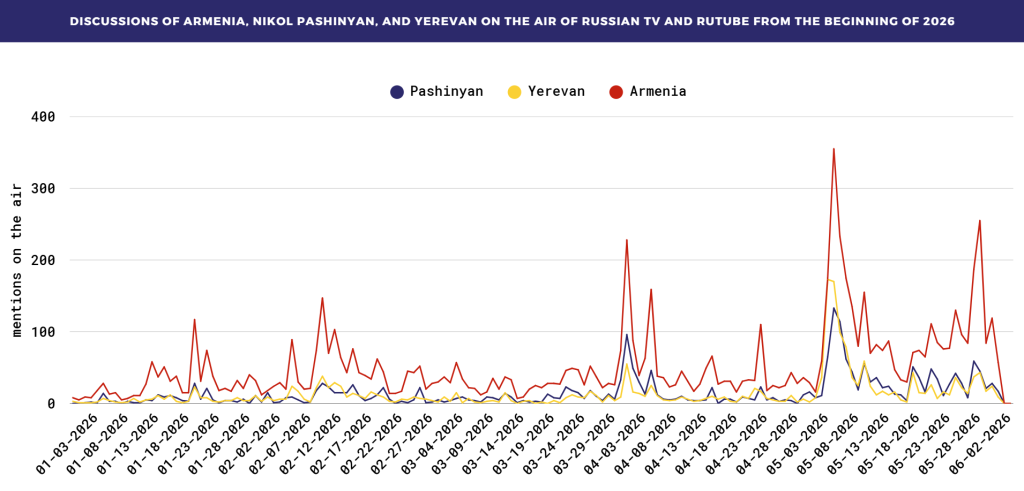
13.01 — Statements by Vladimir Solovyov about a potential “special military operation” in Armenia ahead of Foreign Minister Mirzoyan’s visit to the United States. The Russian ambassador was summoned to the Armenian Foreign Ministry in Yerevan.
20.01 — Lavrov’s statement regarding a “Moldovan scenario” and remarks defending pro-Russian politician Vardan Ghukasyan, former mayor of Gyumri. Solovyov further developed the Karabakh narrative.
Solovyov:
“Armenians lived in Karabakh, and now not a single person remains there. The realization of the scale of this tragedy will come much later. The persecution of the Armenian Apostolic Church is also no coincidence. This is a terrible night that has descended upon Armenia. How this great nation will endure it, and what efforts will be required to emerge from this condition, is a separate, large, and complex issue. All of this is happening in a region surrounded by such ‘wolves’ that they will tear apart everything they can in an instant.”
Bagdasarov:
“Yes, unfortunately, you are absolutely right. This is an extremely difficult moment, perhaps comparable to the period preceding the genocide of 1915–1923. It may end in something that many in Armenia may still not fully understand: Armenia could face the same fate as Nagorno-Karabakh. The Armenian population could be displaced and pushed out from its historic territory.”
“I prefer to call the republic Eastern Armenia, because 5–7% of historic Armenian lands cannot be called the entire Republic of Armenia. That is complete absurdity. Nevertheless, Armenian statehood has survived. And it survived thanks to Russia, thanks to the Russian state. Anyone who knows Armenian history understands this perfectly.”
22.01 — Armenian Prime Minister Nikol Pashinyan announced plans to integrate the energy systems of Armenia and Azerbaijan. Armenia also joined Trump’s Peace Summit initiative. Continued promotion of the “Moldovan scenario” narrative.
FEBRUARY
05.02 — During a meeting with Armenian National Assembly Speaker Alen Simonyan, Lavrov “dismissed” allegations of Russian threats toward Armenia and claimed that the EU seeks to foster distrust and false narratives between Armenia and Russia.
Lavrov:
“…I would note attempts to cast doubt on our shared history, and we will always honor the memory of the contribution the Armenian people made to the victory over Nazism.”
10.02 — Visit of J.D. Vance to Armenia. Narratives regarding NATO’s alleged “interests” in the South Caucasus (“They have intruded into our region…”)
12.02 — Continued discussion of Vance’s visit, accompanied by Zakharova’s statements about Armenia’s supposedly “free choice.”
APRIL
01.04 — Pashinyan’s visit to the Kremlin. Putin commented on the arrest of a pro-Russian oligarch.
23.04 — Active promotion of the narrative that the West is attempting to “push Russia out of the Caucasus,” alongside intensified lobbying efforts on behalf of pro-Russian political forces, including the Strong Armenia party and the Armenia bloc, through platforms such as Sputnik, Yerevan Today Rus, and Krym24.
MAY
05.05 — EU Summit in Armenia. Federal Russian media actively promoted Eurosceptic narratives, themes of “betrayal,” and efforts to discredit Zelenskyy. Continued dissemination of the “Moldovan scenario” narrative and comparisons with Romania.
10.05 — Peskov accused the Armenian leadership of providing a platform for anti-Russian statements, particularly those made by Zelenskyy. At the same time, he emphasized that Armenia itself had not publicly voiced claims against Russia. This messaging appeared aimed at appealing to the Armenian diaspora and pro-Russian Armenians as a potential allied constituency in contrast to the West, effectively serving as an attempt at electoral mobilization.
29.05 — Putin made statements about the “warm” nature of Russian-Armenian relations, highlighting Armenia’s “enormous” economic potential, the prospects for continued investment, and the benefits of maintaining close economic ties within existing Eurasian integration frameworks. These messages were framed as evidence of the tangible economic advantages of preserving strategic cooperation with Russia amid ongoing discussions about Armenia’s future geopolitical orientation.