SECOND ROUND OF ELECTIONS IN MOLDOVA: involvement of Russian propaganda

SECOND ROUND OF ELECTIONS IN MOLDOVA: involvement of Russian propaganda

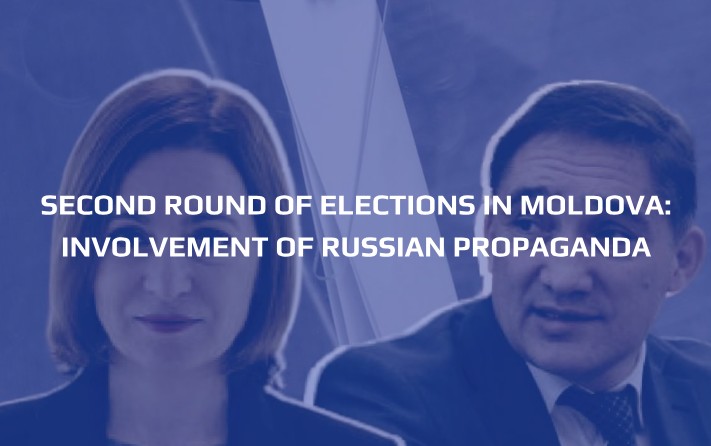
Media monitoring of the first round of the presidential elections in Moldova revealed clear signs of a targeted information campaign from the Russian Federation aimed at swaying the vote. Discussions in Russian media, especially on propaganda television channels and the Telegram platform, frequently featured sharp criticism of President Maia Sandu and her political agenda. The share of sources distributing propaganda materials on Telegram was 31%, twice the average. This was the level of Russian propaganda involvement before and during the first round of the presidential elections in Moldova.

The subsequent analysis conducted by the Institute for Conflict Study and Analysis of Russia indicated that, between the first round of voting and the announcement of the results for the second round, Russian media continued their campaign against Maia Sandu, thereby intensifying efforts to influence the election outcomes in Moldova.

Russian television often portrayed President Sandu negatively during this time, mentioning her far more frequently than her opponent, opposition candidate Alexander Stoianoglo. Both candidates received considerable attention in Russian Telegram, where discussions also leaned heavily negatively toward Ms. Sandu and her pro-European policies.

Between October 22 and November 4, 2024, over 1,500 original posts were published, accumulating nearly 9 million views. The peak viewership occurred on election day and October 25, just before Georgia’s parliamentary elections.

Notably, on election day, the share of compromised sources covering the second round of Moldova’s presidential elections exceeded 26%, mirroring similar figures from Georgia’s election day.

The active role of Russian propaganda and its attempts to influence the presidential elections in Moldova underscore Russia’s commitment to shifting the country’s geopolitical direction. The involvement of propaganda and compromised sources was twice the average observed in other information campaigns and influence operations.

Related publications

Election and Post Election Day in Armenia: Russian information influence and framing
Analytics

Election and Post Election Day in Armenia: Russian information influence and framing

Executive Summary On the day of Armenia’s parliamentary elections, debate focused on two core issues: the legitimacy of the government and the country’s sovereignty in shaping its future. Prime Minister Nikol Pashinyan and his government emphasized anti-corruption measures, efforts to prevent vote-buying, and tighter oversight of the electoral process. They also framed the election as…

Election and Post Election Day in Armenia: Russian information influence and framing
Russian FIMI in the Armenian Elections
Analytics

Russian FIMI in the Armenian Elections

Overview of Recent Trends Ahead of Armenia’s parliamentary elections, the information environment surrounding the country shows signs of an intensifying and increasingly sophisticated Russian influence campaign. This campaign extends beyond traditional information and propaganda tools, encompassing a broader combination of media, economic, political, and institutional pressure. For Moscow, these elections are significant not only as…

Russian FIMI in the Armenian Elections
Russian Influence on the 2026 Elections in Armenia: Main Approaches and Risks
Analytics

Russian Influence on the 2026 Elections in Armenia: Main Approaches and Risks

Executive Summary The parliamentary elections in Armenia, scheduled for June 7, 2026, are becoming another testing ground for Russia to apply its influence instruments previously deployed during the elections in Georgia and Moldova in 2024–2025. The core elements of this strategy include the exploitation of fear of war, the promotion of frozen conflict narratives, particularly…

Russian Influence on the 2026 Elections in Armenia: Main Approaches and Risks
System of Sanctions Evasion: IKAR’s Investigation
Analytics

System of Sanctions Evasion: IKAR’s Investigation

From “Shadow” to “State”: The True Nature of Russia’s Maritime Sanctions Evasion System The IKAR investigation series sequel demonstrates that the “shadow fleet” is not an incidental or unintended byproduct of sanctions policy. Rather, it constitutes a deliberate, integrated element of Russia’s state economic and security strategy. Its operations systematically undermine the effectiveness of the…

System of Sanctions Evasion: IKAR’s Investigation